What a Travel Concierge Actually Does, and What It Costs (2026)
A plain explanation of the concierge model: what a brief contains, what comes back, how the money works across the industry, and what happens when a flight cancels overnight.
By Biirdee Team · September 11, 2026
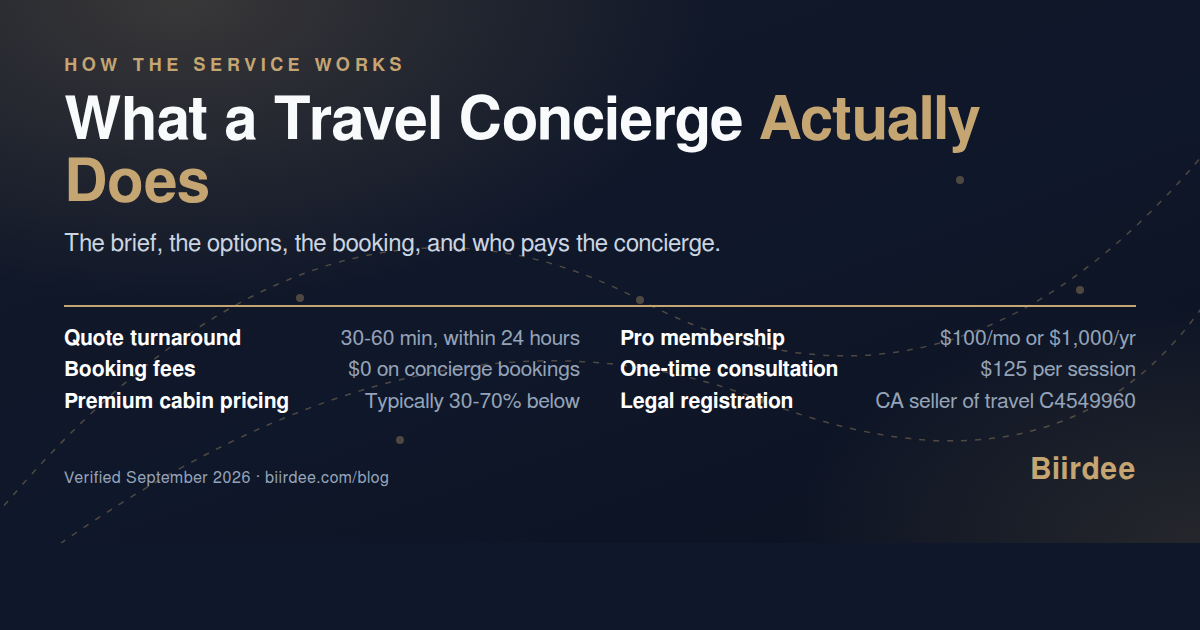
A travel concierge takes your constraints and hands back a short list of decided options, then owns the booking until you are home. A search engine hands back four hundred results and a confirmation email, and the rest is yours at 2 a.m. in a terminal in Doha.
This post explains the model end to end for someone who has never used one. What a brief looks like. What comes back and how fast. How booking and payment work. What happens when a flight cancels overnight. How concierges are paid across the industry, and how we price it at Biirdee. Our guide on what a travel concierge does answers the question in short form. This one goes further into the mechanics and the money. Prices, rules and response times are current as of September 2026 and will change, so treat every figure as a benchmark to check.
The Job Has Two Halves
Most people picture only the first half.
The first half is the search. A concierge works channels a public search does not surface: consolidator contracts with airlines, award space across partner programs, preferred-partner rates and perks at hotels, operator pricing on charter. The work is comparing those against the published fare for your exact route, dates and cabin, then discarding everything except the two or three options worth your attention.
The second half is ownership. Once the ticket is issued, the desk holds the file. Seat assignments, meal requests, frequent flyer numbers, lounge access, wheelchair assistance, a greeter at the gate, a change three weeks later, a cancellation at midnight. That half is invisible when a trip goes well and is the entire product when it does not.
What a Brief Looks Like
A brief is not an itinerary. It is a constraint set, and the tighter it is, the better the first reply. Six things carry most of the weight.
- The fixed points. What cannot move. A board meeting on the 14th, a wedding on the 3rd, a return before school starts. Everything else is negotiable, and the negotiable parts are where the savings live.
- The route, including every airport you will accept. SFO, SJC and OAK are three different fare markets. So are LHR and LGW. Naming all of them widens the search. Naming one narrows it for a reason the concierge should know about.
- The cabin and the floor. Business or first, and whether you would take premium economy on a short connecting leg to keep the long leg flat. A floor is more useful than a ceiling.
- The budget, stated honestly. This is the item people soften, and softening it costs them. A real number lets the concierge stop searching at the right point instead of building an itinerary you were never going to buy.
- The preferences that survive fatigue. Aisle. No red-eyes eastbound. Lounge access matters or it does not. A specific dietary need. Three of these are useful. Twenty is a personality profile.
- The parts you would rather handle yourself. Some people want the flights solved and the hotel left alone. Say so in the first message. It saves a round trip of email.
Our how it works page follows the same sequence: request, options, review, book. A first brief takes about a minute to write and commits you to nothing.
What Comes Back, and How Fast
As of September 2026, a concierge reply should contain four things and arrive on a stated clock.
- Options, not results. Two or three itineraries with a reason attached to each. The cheapest, the fastest, the one with the connection that will not strand you. If twenty lines come back, you have been handed a search rather than advice.
- The total price in writing. The full itinerary, the fare rules and the all-in price before you pay anything. At Biirdee the price quoted is the price you pay, and the quote itself is free with no card required.
- The trade-off named out loud. Contracted fares are typically tighter than the flexible published fares they undercut. Expect change fees, restricted refundability, and sometimes reduced mileage earning by booking class. Those terms belong in writing before you pay, not in a discovery three months later.
- A clock you can plan around. Biirdee quotes usually land in 30 to 60 minutes and always within 24 hours. Complex multi-city and private jet requests typically take two to four hours. First replies on WhatsApp average under four minutes during peak hours, as of September 2026.
Nothing is booked until you say the word. The quote is the product at this stage, and it costs you nothing to compare it against what you found yourself.
How Booking and Payment Work
You approve an option and the concierge issues the ticket. Within a day you should hold a 13-digit e-ticket number, and the booking should appear when you enter the record locator on the airline's own website. If it does not appear there, something is wrong and you should say so that day.
Payment is ordinary. Biirdee accepts bank transfer, which is preferred, along with major credit cards, Zelle and crypto, and recommends bank transfer above $10,000 to avoid card processing fees. Depending on the route and the program, credit card points or airline miles can cover part or all of a booking. The full list sits on our FAQ. Charter works differently: a deposit secures the aircraft with full payment due before departure, and private charters start from $10,000.
Hotels are different again. At a preferred partner the concierge books the same rate the hotel's own site shows, and the property pays the commission out of that rate. You are not paying extra for the upgrade priority, the breakfast or the property credit. The channel is.
The 2 A.M. Test: What Happens When a Flight Cancels
Here is the scenario that decides whether the service was worth it. Your 11:40 p.m. departure cancels at the gate. Two hundred people are now in one line and on one phone number, and the airline app is offering you a seat 31 hours later.
A concierge desk is a second line into the same inventory, already holding your file. It knows the fare rules on your ticket, which partner airlines you can be reprotected onto, which routing the airline will accept without a fare difference and which one it will refuse. Biirdee includes 24/7 support and flight monitoring on concierge bookings, and handles changes, cancellations and rebooking on your behalf, including outside business hours. One published client review, from a senior PeopleOps director at RingCentral, describes exactly this pattern on last-minute executive flights.
Now the honest counter-case. Because a contracted fare exists under the agency's contract, changes, cancellations and refunds run through the agency rather than the airline's call center or app. That is an advantage at 2 a.m. and an inconvenience at 2 p.m. on a Tuesday when you want to move a seat yourself in thirty seconds. If self-service matters more to you than a person, book direct and keep it simple.
How Concierges Get Paid
Nobody in this business works for free, and the model sets the incentive. Ask which one applies before you ask anything else. The answer should take one sentence, and hesitation is itself information.
There are four structures money reaches a concierge through, and most firms run two or three at once.
The Four Models
As of September 2026, these are the structures you will encounter.
- Supplier commission. The hotel, cruise line, tour operator or transfer company pays the advisor a percentage of the booking, out of the rate you would have paid anyway. This is the oldest model and the reason preferred-partner perks attach without changing the price. The incentive risk is plain: not every supplier pays, and you want an advisor who still tells you when the right property is a non-commissionable one.
- Planning or service fees. The advisor charges you directly, per trip or per itinerary, sometimes credited back against a booking. This is common for complex multi-country travel where the work is research rather than transaction. It aligns the incentive cleanly, because you are the client rather than the supplier.
- Membership or retainer. You pay a recurring fee for access, priority and better pricing. Agency memberships, private clubs and card programs all sit here. It suits people who travel often enough to amortize the fee across many bookings, and it is poor value for one trip a year.
- The fare spread. The agency holds a wholesale contract with an airline that prices a seat below the published fare, and the margin sits inside the discounted price you are quoted rather than on top of it. Same seat, same airline ticket stock, same reservation in the airline's system. Only the fare channel differs.
A fifth arrangement sits alongside these: the card issuer's travel desk, which you reach because you hold the card and whose cost is folded into the annual fee you already pay. Our guide on why travel agents still exist works through the economics of each model in more detail.
How Biirdee Prices It
We use the fare spread on flights and supplier commission on hotels and ground. As of September 2026, the specifics are these.
- Concierge bookings carry no booking fee. The agency earns inside the fare spread, so there are no booking fees and no membership is required. You see the full itinerary, the fare rules and the total price in writing before paying anything.
- Premium cabins typically price below published fares. We negotiate rates with more than 45 major carriers, and every quote is priced individually against the published fare so you see both. Savings vary by route, season and availability, and when we cannot beat the published fare we say so.
- Hotels are paid for by the property. We hold preferred-partner relationships across a portfolio of more than 500 properties. Outside the strict rate-parity brands that can mean 5 to 40 percent off standard rates. At the parity brands it does not, and the gain is the perks attached at the same rate.
- The paid tiers are optional, and never a prerequisite for a quote. A one-time miles and trip planning consultation is $125 per session. Biirdee Pro is $100 a month or $1,000 a year, cancel anytime, and adds net rates, a dedicated concierge, unlimited fare checks and price-drop monitoring. The free account includes five fare checks a month. The pricing page has the full comparison.
- Where we are not the answer. We specialize in international business and first class. Availability for US domestic routes and economy tickets is limited to none, and for those you should book direct. We say that even though it earns us nothing.
Concierge, Agent, Card Desk, or Yourself
The four channels overlap enough to confuse, and the differences matter most on the day something goes wrong.
- A traditional travel agent: sells packaged product across a broad catalog, is usually paid by supplier commission, and is genuinely strong on cruise, tour and resort inventory. The relationship tends to be transactional, one booking at a time.
- A travel concierge: is one named person who holds your file across trips, prices cash against points on every request, and owns servicing after the ticket is issued. The test is whether the same human answers next time and already knows your aisle preference.
- A card travel desk: is a call center attached to your card. It handles the standard case well and can attach the card program's published hotel benefits at participating properties. You reach a different agent each time, and the desk works inside the issuer's own portal inventory.
- Doing it yourself: is correct more often than any agency will admit. Simple domestic round trips, economy fares, a single hotel night, any route where the published price is already low and the routing is obvious. If you enjoy the search and the trip is straightforward, keep the control.
Our honest answer on whether to use a travel agent includes the cases where the answer is no. If you have recently come into liquidity and are rebuilding how you travel from scratch, the companion post on how to travel after a liquidity event covers sequencing, and why Biirdee is built for tech and knowledge workers explains why the desk is set up the way it is.
How to Brief Well
Five habits separate the briefs that produce good options from the ones that produce three rounds of email.
- Lead with the constraint, not the destination. A concierge can build ten routes to Tokyo. Only one of them respects a Thursday board meeting and a preference against overnight eastbound flights.
- Say the number. Budget honesty is the single highest-leverage thing you can do. It is not a negotiating position, and withholding it produces quotes you will decline.
- Let them price one leg at a time. Booking a trip leg by leg can open more strategies and better pricing than insisting on one combined ticket. Ask whether splitting helps before you rule it out.
- Name your programs and balances. Cash and points are not separate decisions. If you hold meaningful balances across Amex, Chase, Capital One or an airline program, say so at the start so both paths get priced.
- Answer fast when inventory is live. Award space and contracted seats move. A quote with a confirmed seat behind it has a shelf life measured in hours, not days, and the honest desks will tell you which ones are fragile.
What a Concierge Cannot Do
The limits are as useful to understand as the capabilities.
- Create a seat that does not exist. If a route has no premium inventory on your dates, no contract and no program conjures one. The useful answer is a different date, a different routing, or a different carrier.
- Beat every published fare. Some routes and seasons price low enough that the public fare wins. A good desk tells you that and books nothing.
- Guarantee an upgrade. Hotel upgrades, early check-in and late checkout are priority, not promises, and remain subject to availability on the day. Anyone guaranteeing them is describing something they do not control.
- Undercut a rate-parity brand. At Aman, Four Seasons, Rosewood, Mandarin Oriental and their peers, no reputable channel prices below the brand's own site. Our playbook on booking luxury hotels for less is explicit about where the discount exists and where it does not.
- Break a program's rules. Miles have terms. Consolidator fares have terms. Anything that requires misrepresenting a booking puts your ticket and your account at risk, and a concierge worth using will decline it.
- Stand in for a professional. Tax questions about where you fly and stay, legal questions about residency, and serious personal security planning belong to the relevant professional, not a travel desk. Our post on travel privacy and security after a liquidity event covers what travel logistics can and cannot address.
How to Judge a Good One
Four checks, all of which you can run before you spend anything.
- Ask how they are paid. Commission, fee, membership or fare spread. The answer should be immediate and specific, and it should tell you which suppliers pay them and which do not.
- Get the terms in writing before you pay. Full itinerary, fare rules, change and refund terms, earning class, total price. A verbal number with the conditions to follow is not a quote.
- Verify the ticket yourself. Within a day of paying you should hold a 13-digit e-ticket number, and the reservation should load on the airline's own website under its record locator. Paying by credit card preserves chargeback protection if it does not.
- Ask about accreditation and registration. Legitimate agencies reselling consolidator fares hold ARC or IATA accreditation, and sellers of travel are registered in several states. Biirdee Inc. is a registered California Seller of Travel, registration number 2138352, based in Burlingame, California. Registration as a seller of travel does not constitute the state's approval.
- Watch what they decline. A desk that never tells you to book direct is selling rather than advising. The refusals are the signal.
Frequently Asked Questions
- What does a travel concierge actually do? Two things. It finds and prices options across channels a public search does not show, including consolidator fares, award space and preferred hotel rates. Then it owns the reservation after ticketing: seats, meals, frequent flyer numbers, lounge access, changes, and rebooking when something breaks.
- What does it cost to use one? It depends entirely on the model. Commission and fare-spread agencies are free to the traveler because the supplier pays, fee-based advisors charge per trip, and membership programs charge a recurring fee. At Biirdee, concierge bookings carry no booking fee and no membership requirement, and the optional tiers are a $125 one-time consultation or Pro at $100 a month or $1,000 a year, as of September 2026.
- Is a concierge cheaper than booking direct? On international business and first class, often. Biirdee typically prices premium cabins below published fares through consolidator contracts and award inventory, though savings vary by route, season and availability, and when we cannot beat the published fare we say so. On luxury hotels at rate-parity brands the rate matches booking direct, and the gain is the perks attached to it.
- What is the catch on a discounted fare? Fare rules are typically tighter than the flexible published fares they undercut. Expect change fees, restricted refundability, and sometimes reduced mileage earning by booking class. Those terms should be stated in writing before you pay, and servicing runs through the agency rather than the airline's app.
- When should I skip the concierge entirely? US domestic trips, economy tickets, a single hotel night, or any itinerary where the published fare is already low and the routing is obvious. Book direct and keep the control. A desk unwilling to tell you this is selling rather than advising.
Prices, fare rules and response times in this post were verified in September 2026 and will change. Confirm the current figure before you book.
Biirdee · Flight Concierge
Put the Model to the Test
Tell us the route, the dates and the cabin, and anything that cannot move. We will come back with options, the fare rules, the all-in price, and whether cash or points is the better way to pay for it.
Questions?[email protected]
Prefer to book it yourself at net fares?
Biirdee Pro members book flights & hotels at net rates: $100/mo, cancel anytime.