Chase Sapphire Reserve vs Amex Platinum (November 2026): Which Card Is Better?
The $795 card against the $895 card, compared on fees, credits, points, lounges, hotels and insurance using only Chase's and American Express's own pages, with a verdict for each kind of traveler.
By Biirdee Travel, Luxury Travel Concierge · Updated November 17, 2026
The Short Answer
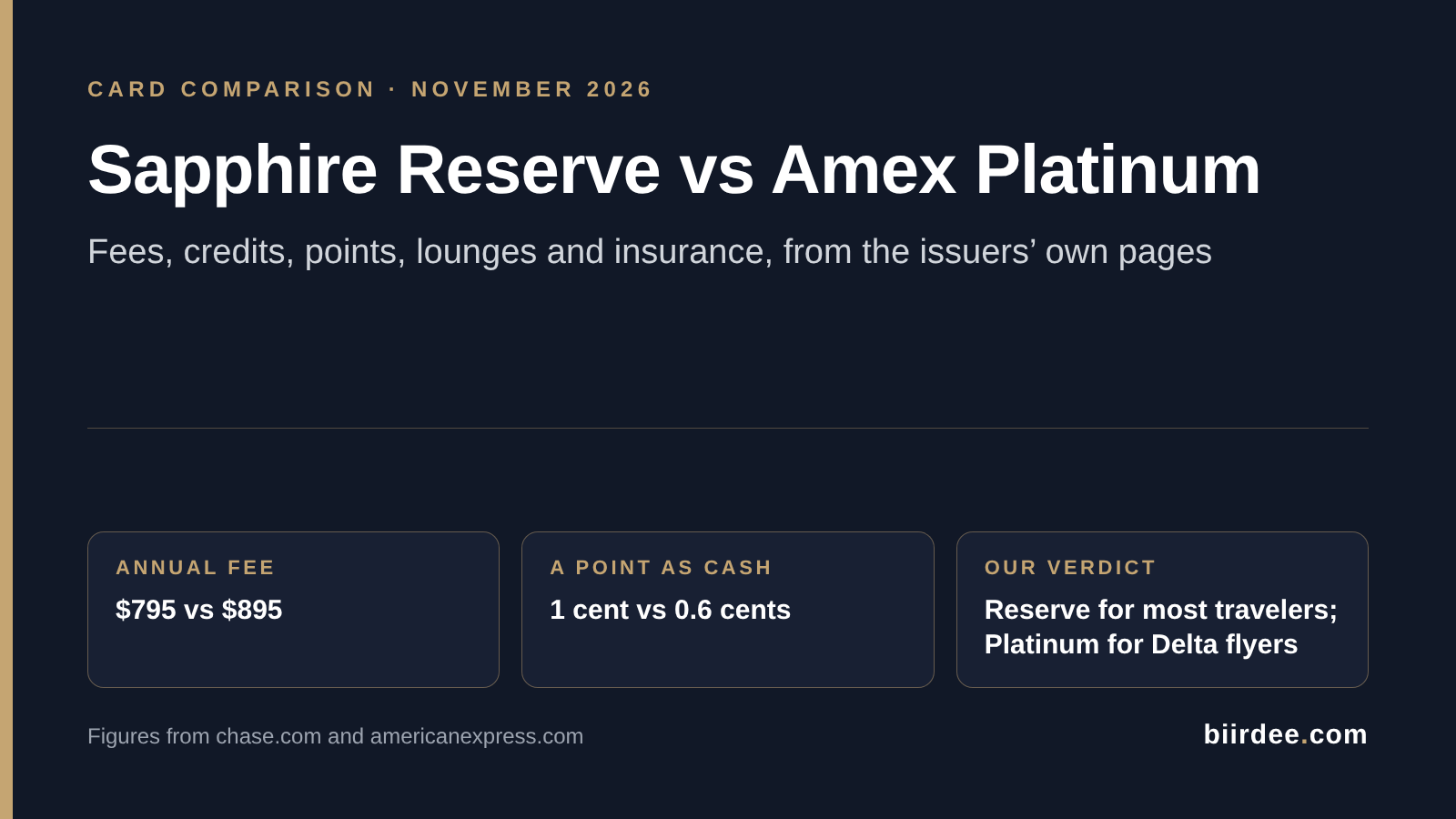
As of November 2026, the Chase Sapphire Reserve is the better card for most travelers who will carry one premium card, and the American Express Platinum Card is the better card for a narrower traveler: someone who flies Delta, uses Centurion Lounges alone, wants to move points to ANA, Cathay Pacific, Emirates or Qatar Airways, and will really spend credits that arrive as monthly and quarterly coupons. The Reserve costs $795 a year against $895, gives $300 of that back on any travel purchase with nothing to enroll in, earns 3x on dining and 4x on hotels booked direct where the Platinum earns 1x, lets you cash points out at 1 cent each where Amex pays 0.6 cents, and carries primary rental car cover and trip delay cover for each traveler.
The Platinum answers with reach. Its lounge network is the bigger one (more than 1,550 lounges, including 30-plus Centurion spaces and ten Delta Sky Club visits a year), its 21 transfer partners include eight airlines Chase does not have, and it earns 5x on airfare against Chase's 4x. Its statement credits and Uber Cash add up to $2,694 a year at face value, against about $2,060 in credits and promos on the Reserve plus two Apple subscriptions and a DashPass membership that Chase values at $444. The catch is how the Platinum pays: $25 a month here, $75 a quarter there, each tied to one merchant. Nothing on it works like the Reserve's $300 travel credit.
Every fee, rate, credit and limit on this page comes from Chase's and American Express's own pages, read on 17 November 2026 and listed in the Sources table at the end. The verdicts are ours. Biirdee is a travel concierge, and there are no card application links on this page. Issuers change terms often, so check the offer on the issuer's own page before you apply.
Key Takeaways
- Our verdict: Sapphire Reserve for most travelers holding one premium card; Amex Platinum for Delta flyers, solo lounge users and anyone collecting points for ANA, Cathay Pacific, Emirates or Qatar Airways awards.
- Fees: $795 a year for the Reserve, $895 for the Platinum, and $195 for each extra cardholder on both. Neither charges foreign transaction fees.
- Welcome offers on 17 November 2026: Chase publishes 100,000 points after $6,000 of purchases in three months. Amex offers "as high as" 175,000 points after $12,000 in six months, and only tells you your number after you apply.
- Earning: the Reserve pays 8x through Chase Travel, 4x on flights and hotels booked direct, 3x on dining. The Platinum pays 5x on flights and on prepaid hotels booked through Amex Travel, and 1x on everything else, restaurants included.
- A Chase point is worth 1 cent as cash, gift cards or travel, and up to 2 cents on select Points Boost bookings. An Amex point is worth 0.6 cents as a statement credit and 1 cent on flights booked through Amex Travel.
- Transfer partners: Chase has 14 (the only route to United, Southwest, Hyatt, IHG and Wyndham). Amex has 21 (the only route to ANA, Delta, Cathay Pacific, Emirates, Qatar Airways, Qantas and Hilton), with Cathay and Emirates at 1,000 points to 800 miles.
- Lounges: Chase admits two guests free at its Sapphire Lounges and at Priority Pass lounges. Amex has the larger network, but Centurion Lounge guests cost $50 each unless the account spends $75,000 in a calendar year.
- Insurance: the Reserve's rental car cover is primary and its trip delay cover pays up to $500 for each traveler; the Platinum's rental cover is secondary and its trip delay cover pays up to $500 a trip, though it adds cell phone protection.
Sapphire Reserve vs Amex Platinum at a Glance
Figures as published by Chase and American Express on 17 November 2026. The welcome offers are the public ones on each issuer's product page; both issuers say offers vary by channel and over time.
| Chase Sapphire Reserve | Amex Platinum | |
|---|---|---|
| Annual fee | $795 | $895 |
| Each extra cardholder | $195 per authorized user | $195 per Additional Platinum Card; Companion Platinum Cards carry no fee and no lounge access |
| Welcome offer | 100,000 points after $6,000 of purchases in the first 3 months | As high as 175,000 points after $12,000 of purchases in the first 6 months; your amount is shown after you apply and may be lower, or nothing |
| Flights | 4x booked with the airline, 8x through Chase Travel | 5x booked with the airline or through Amex Travel, on up to $500,000 a year |
| Hotels | 4x booked with the hotel, 8x through Chase Travel | 5x on prepaid bookings through Amex Travel; 1x booked with the hotel |
| Dining | 3x worldwide | 1x |
| Everything else | 1x | 1x |
| A point as cash | 1 cent | 0.6 cents |
| Best published travel value | Up to 2 cents on select Points Boost flights and hotels | 1 cent on flights and Fine Hotels + Resorts through Amex Travel |
| Transfer partners | 10 airlines and 4 hotel programs | 16 airlines, 4 hotel programs and 1 retailer |
| Lounges | 8 Chase Sapphire Lounges (New York JFK temporarily closed), 1,300+ Priority Pass lounges, select Air Canada lounges | 1,550+ lounges: 30+ Centurion spaces, 10 Delta Sky Club visits a year, Priority Pass, Plaza Premium, Escape |
| Lounge guests | Two free at Sapphire and Priority Pass lounges | Two free at Priority Pass and Plaza Premium; $50 each at Centurion Lounges unless you spend $75,000 a year |
| Travel credit | $300 a year on any travel purchase, applied automatically | None of that kind; $200 a year for incidental fees on one airline you choose |
| Hotel credit | $500 a year at The Edit: $250 per prepaid stay of two nights or more | $600 a year at Fine Hotels + Resorts or The Hotel Collection: $300 per half-year, prepaid |
| Hotel status | IHG One Rewards Platinum Elite through 31 December 2027 | Hilton Honors Gold, Marriott Bonvoy Gold Elite, Leaders Club Sterling |
| Rental car cover | Primary, up to $75,000 | Secondary |
| Trip delay cover | Up to $500 per covered traveler after 6 hours or an overnight stay | Up to $500 per trip after 6 hours, two claims per 12 months |
| Foreign transaction fee | None | None |
| Purchase APR | 19.74% to 28.24% variable | 19.74% to 28.74% variable on Pay Over Time; the card has no preset spending limit |
The Fee Is Not the Price: What Each Card Gives Back
Both issuers advertise more value than they charge: Chase says the Reserve carries "more than $3,000 in annual value" and Amex says the Platinum unlocks "$3,500+". Both totals count a figure of about $850 for lounge access and every credit at face value. A more useful test is narrower: count a credit only if you would have spent that money, at that merchant, in that window, without the card.
By that test, the Reserve's $300 travel credit is the one credit on either card that almost everyone uses in full. It applies by itself to airlines, hotels, car rentals, cruises, travel agencies, trains, taxis, tolls and parking, and it runs on your account anniversary year. For anyone who travels at all, that makes the Reserve's working fee $495. The Platinum has no equivalent. Its nearest credit, $200 for airline fees, covers only incidentals such as checked bags on one airline you pick in advance, and Amex's terms exclude airline tickets, upgrades and award tickets.
So the Platinum's $895 has to be earned back one credit at a time, and the Reserve's remaining $495 does too. The two tables below list every credit each issuer publishes, how it pays out and what limits it.
Chase Sapphire Reserve Credits and Their Catches
The four statement credits at the top come to $1,400 a year. With the Lyft, Peloton and DoorDash lines the face value is $2,060, and Chase values the Apple subscriptions and DashPass at a further $444.
| Credit | Face value | How it pays | The catch |
|---|---|---|---|
| Travel credit | $300 a year | Automatic statement credit on travel purchases, each account anniversary year | The covered spend earns no points |
| The Edit hotel credit | $500 a year | Up to $250 per prepaid booking of an Edit hotel through Chase Travel, per calendar year | Two-night minimum; Edit hotels only; the covered spend earns no points |
| Dining credit | $300 a year | Up to $150 from January to June and $150 from July to December | Only at Sapphire Reserve Exclusive Tables restaurants on OpenTable, a list of over 400; the charge must be made directly with the restaurant, so gift cards and delivery platforms do not count |
| StubHub and viagogo | $300 a year | Up to $150 per half-year | Activation required; ends 31 December 2027 |
| DoorDash | $420 a year in promos, plus DashPass | $15 a month off one order and two $10 promos a month on non-restaurant orders | A promo not used in its month does not roll over; through 31 December 2029 |
| Apple TV and Apple Music | $324 a year by Chase's valuation | Complimentary subscriptions for at least 12 months | Activate by 22 June 2027 |
| Lyft | $120 a year | $10 of in-app ride credit a month, plus 5x points on Lyft | Credit unused at the end of a month is forfeited; rides only, not fees, taxes or tips; through 30 September 2027 |
| Peloton | $120 a year | $10 a month toward an eligible membership | Activation required; through 31 December 2027 |
| Select Chase Travel hotels | Up to $250 | Prepaid Chase Travel stays with IHG, Montage, Pendry, Omni, Virgin, Minor or Pan Pacific hotels | Two-night minimum; ends 31 December 2026 |
| Global Entry, TSA PreCheck or NEXUS | Up to $120 | One application fee credit every four years | Not an annual credit |
Amex Platinum Credits and Their Catches
The ten annual credits here come to $2,694 a year at face value; the Global Entry credit comes once every four years. Amex's benefit terms also still carry a $300 Equinox credit that its product page does not list, so we have left it out. Most Platinum credits need a one-time enrollment in your Amex account before they pay.
| Credit | Face value | How it pays | The catch |
|---|---|---|---|
| Hotel credit | $600 a year | Up to $300 from January to June and $300 from July to December on prepaid Fine Hotels + Resorts, The Hotel Collection or Airbnb Luxe bookings through Amex Travel | The Hotel Collection needs two nights, and from 1 January 2027 Fine Hotels + Resorts does too |
| Resy | $400 a year | Up to $100 a quarter at over 10,000 US restaurants on Resy | Enrollment required; an unused quarter is lost |
| Digital entertainment | $300 a year | Up to $25 a month | Only Disney+, ESPN, Hulu, The New York Times, Paramount+, Peacock, The Wall Street Journal, YouTube Premium and YouTube TV |
| lululemon | $300 a year | Up to $75 a quarter | US stores and lululemon.com; outlets excluded |
| Uber Cash | $200 a year | $15 a month, plus $20 more in December | US rides and orders only, paid with an Amex card |
| Uber One | $120 a year | Statement credits on an auto-renewing membership | The membership fee must be charged to the card; US Uber accounts only |
| Airline fee credit | $200 a year | Incidental fees on one airline, per calendar year | You choose Alaska, American, Delta, JetBlue, Southwest or United in advance; airline tickets, upgrades, miles purchases and award tickets do not count |
| CLEAR+ | $219 a year | Statement credit on a CLEAR+ membership | Only useful if you want CLEAR |
| Walmart+ | $155 a year | Up to $12.95 a month, plus tax, on a monthly membership | Monthly membership only |
| Oura Ring | $200 a year | Statement credit on a ring bought at ouraring.com | The ring only; Oura membership and accessories are excluded |
| Global Entry or TSA PreCheck | $120 or up to $85 | One application fee credit every four years | Not an annual credit |
Who Actually Clears the Fee
A traveler who books two prepaid luxury hotel stays a year, eats out in a large US city, rides Uber and pays for one of the listed streaming services can use the Platinum's hotel, Resy, Uber Cash and entertainment credits without changing a habit. That is $1,500, well past the $895 fee. The same traveler on the Reserve uses the $300 travel credit and the $500 Edit credit for certain, which already covers the $795 fee, and the $300 dining credit only if a restaurant they like is on the Exclusive Tables list.
A traveler who takes three or four trips a year, stays in ordinary hotels and does not live on delivery apps gets a different result. The Reserve still returns $300 on the first flight or hotel of the year. The Platinum returns very little: its hotel credit needs a prepaid booking at one of the 3,100-plus hotels on Amex's two lists, and the rest depends on Resy, Uber, lululemon and subscriptions. That gap is the main reason we rank the Reserve first for most people.
Watch the calendar on both. Several of the Reserve's partner credits end in 2027, and the pages we read do not say what follows them. The Platinum credits reset by month, quarter or half-year, so a missed period is simply lost.
Earning Points: Chase Wins Everywhere Except Airfare
The Platinum earns 5 points per dollar on flights booked with the airline or through Amex Travel, on up to $500,000 of airfare a calendar year, and on prepaid hotels booked through Amex Travel. Everything else earns 1 point: restaurants, a hotel booked on the hotel's own site, groceries, the rest of life.
The Reserve earns 4 points on flights and hotels booked direct, 8 points on all purchases through Chase Travel, The Edit included, 3 points on dining worldwide including takeout and eligible delivery services, and 1 point elsewhere. Purchases that the $300 travel credit or The Edit credit pays for earn nothing.
So the Platinum leads by one point per dollar on airfare booked with the airline, and trails by two points per dollar on dining and three on a hotel booked direct. Unless airfare is most of what you charge, the Reserve earns more. The example below shows a $50,000 year.
Points Earned on a $50,000 Year
Our arithmetic from the published earn rates, before any welcome offer and ignoring the small amount of travel spend the Reserve's credits cover. The last row assumes all the travel is booked through the issuer's own travel site, with hotels prepaid.
| Annual spending | Sapphire Reserve | Amex Platinum |
|---|---|---|
| $12,000 on flights, booked with the airline | 48,000 | 60,000 |
| $8,000 on hotels, booked with the hotel | 32,000 | 8,000 |
| $6,000 on dining | 18,000 | 6,000 |
| $24,000 on everything else | 24,000 | 24,000 |
| Total | 122,000 points | 98,000 points |
| Total if the travel goes through Chase Travel or Amex Travel | 202,000 points | 130,000 points |
What a Point Is Worth: The Floor and the Ceiling
Chase's program agreement fixes the floor: "each point is worth $.01 (one cent)" when redeemed for cash, gift cards or travel through Chase Travel. Cash means a statement credit or a deposit to a Chase account. On top of that, Points Boost makes Reserve points worth up to 2 cents on select flights and hotels in Chase Travel, The Edit hotels included. The offers rotate. On the day we checked, Chase listed The Peninsula Hong Kong at 42,300 points a night instead of 84,500, and Turkish Airlines business class from New York to Istanbul at 117,000 points instead of 234,000.
Amex publishes its values in a points calculator. For a Platinum Card, 10,000 points are worth $60 as a statement credit or against card charges, $70 at checkout with Amazon, PayPal and similar partners, $70 on prepaid hotels, rental cars and cruises through Amex Travel, and $100 on flights or Fine Hotels + Resorts through Amex Travel. The calculator shows standard values only. Amex's nearest thing to Points Boost is Insider Fares: on select flights through Amex Travel, fewer points are needed when points cover the whole fare. Its terms give no figure for the saving.
That floor changes how a welcome offer should be read. Chase's 100,000 points are worth $1,000 as cash and, by Chase's own claim, up to $2,000 on select Points Boost bookings. Amex's 175,000 points, if you are offered the maximum, are worth $1,050 as a statement credit and $1,750 on flights through Amex Travel. Both currencies can be worth more than any of these figures when moved to an airline or hotel program, which is the next section and the reason most of our readers hold either card.
Transfer Partners: Who Reaches Which Program
Chase lists 10 airline and 4 hotel programs; Amex lists 16 airlines, 4 hotel programs and Fanatics. Chase transfers in 1,000-point blocks. Its Sapphire Reserve for Business page describes the transfer as 1:1, while the personal card's pages list the partners without a ratio, so confirm the rate before you transfer. Amex transfers at 1:1 except where a ratio is shown.
| Reach | Airlines | Hotels |
|---|---|---|
| Both cards | Aer Lingus AerClub, Air Canada Aeroplan, Air France-KLM Flying Blue, The British Airways Club, Iberia Club, JetBlue TrueBlue (Amex at 250:200), Singapore Airlines KrisFlyer, Virgin Atlantic Flying Club | Marriott Bonvoy |
| Sapphire Reserve only | United MileagePlus, Southwest Rapid Rewards | World of Hyatt, IHG One Rewards, Wyndham Rewards |
| Amex Platinum only | ANA Mileage Club, Delta SkyMiles, Cathay Pacific Asia Miles (1,000:800), Emirates Skywards (1,000:800), Qatar Airways Privilege Club, Qantas Frequent Flyer, Avianca LifeMiles, Aeromexico Rewards (1,000:1,600) | Hilton Honors (1,000:2,000), Choice Privileges, Leaders Club (1,000:250) |
What the Partner Lists Mean for First and Business Class
For long-haul premium cabins, the Amex-only column is the stronger one. It is the only route from either card into ANA's own program, which prices its awards from fixed charts (our ANA Mileage Club guide has the rules), into Cathay Pacific's Asia Miles (Cathay Pacific first class), into Emirates Skywards (Emirates first class) and into Qatar Airways' Avios. Two cautions: Cathay and Emirates now take 1,000 Amex points for 800 miles, and Amex transfers to ANA are not instant (our desk plans on one to three days), so the seat can go while the points travel.
The Chase-only column matters closer to home. United MileagePlus is reachable only from Chase of these two (United MileagePlus guide), as are Southwest and World of Hyatt (our Hyatt brands guide covers how the transfer rate differs by Chase card). Chase lets you send points to your own program accounts or to one household member who is an authorized user on the card, and says most transfers finish by the next business day, with up to seven business days possible.
A lot is shared. Singapore KrisFlyer, Flying Blue, Aeroplan, The British Airways Club, Iberia and Virgin Atlantic are on both lists, and between them they book Star Alliance, SkyTeam and oneworld seats, ANA's included through Virgin Atlantic or Aeroplan. If your awards run through those six, the partner lists do not decide this comparison. Whichever card you hold, the rule is the same: find the seat, confirm it books, then transfer, because bank points do not come back. Our airline mileage programs guide compares the programs, and how to redeem airline miles covers the sequence.
Airport Lounges: Bigger Network or Free Guests
Amex has the larger network: more than 1,550 lounges in 140 countries, by its own count as of August 2026. The centerpiece is the Centurion Lounge Network of 30-plus spaces, in US hubs including Atlanta, Charlotte, Dallas/Fort Worth, Denver, Houston, Las Vegas, Los Angeles, Miami, New York (JFK and LaGuardia), Philadelphia, Phoenix, Salt Lake City, San Francisco, Seattle and Washington National, and abroad in cities including London, Amsterdam, Hong Kong, Tokyo, Sydney, Melbourne and Mexico City, with Newark, Boston and a further Charlotte space listed as coming soon. The card also carries ten Delta Sky Club visits a year for each Platinum cardholder, valid on a same-day Delta-operated flight and not on Delta Main Basic (basic economy) fares, plus Priority Pass (after enrollment), Plaza Premium and Escape lounges.
Chase's network is smaller and easier to share. Its own Chase Sapphire Lounges by The Club are in Boston, Dallas/Fort Worth, Las Vegas, New York LaGuardia, Philadelphia, Phoenix and San Diego; the JFK lounge was listed as temporarily closed when we checked and Los Angeles as coming soon. Reserve cardholders also get into the Etihad Lounge at Washington Dulles, more than 1,300 Priority Pass lounges, and Air Canada Maple Leaf Lounges and Cafés in the US, Canada and Europe when flying a Star Alliance airline. Entry to a Sapphire Lounge is within three hours of departure.
Guests are where the two cards part. The Reserve admits two guests free at Sapphire Lounges and Priority Pass lounges ($27 for each one after that) and one free at Air Canada lounges, and authorized users get the same access in their own right. The Platinum admits two guests free at Priority Pass and Plaza Premium lounges, but a Centurion Lounge guest costs $50, or $30 for a child aged 2 to 17, unless the account has spent $75,000 in a calendar year. A couple using Centurion Lounges on one Platinum card pays $50 a visit or $195 a year for a second card. Traveling alone through Centurion or Delta airports, the Platinum is the better lounge card. Traveling as two or more, the Reserve usually is.
Hotels: The Edit vs Fine Hotels + Resorts
Each card has a luxury hotel program that adds perks to a booking made through the issuer's travel site, and a credit that only pays there. The perks are close to identical, and both issuers put the average value at about $550 on a two-night stay. The difference that matters most is checkout: Amex guarantees 4pm at Fine Hotels + Resorts, while Chase offers late checkout at The Edit subject to availability.
On the credits, Amex pays more ($600 against $500) and, until the end of 2026, pays on a one-night Fine Hotels + Resorts stay. From 1 January 2027 both programs need two nights. Chase pays more points on the stay (8x against 5x) and its points can go further toward one, at up to 2 cents each on Points Boost offers against a flat 1 cent at Fine Hotels + Resorts. Amex publishes the size of its lists, over 1,900 Fine Hotels + Resorts properties and over 1,400 in The Hotel Collection; Chase did not publish a count for The Edit on the pages we read.
Hotel status is a clear Amex win for chain loyalists: Hilton Honors Gold and Marriott Bonvoy Gold Elite on enrollment, plus Leaders Club Sterling at The Leading Hotels of the World. The Reserve gives IHG One Rewards Platinum Elite through 31 December 2027. Our hotel loyalty programs comparison sets out what each tier is worth.
Both programs are the card version of something a preferred-partner travel advisor also attaches: breakfast, a property credit and upgrade priority at the hotel's own rate. If you hold either card and the hotel is on its list, use the credit, because no advisor can hand you $250 or $300 back. Where the hotel is not on the list, or you would rather pay at checkout than prepay, the advisor route attaches similar perks; how to book luxury hotels for less explains how the two channels compare.
The Edit vs Fine Hotels + Resorts, Side by Side
| The Edit by Chase Travel | Amex Fine Hotels + Resorts | |
|---|---|---|
| Breakfast | Daily for two | Daily for two |
| Property credit | $100 | $100 toward eligible charges |
| Room upgrade | At check-in, subject to availability | On arrival, when available |
| Check-in and checkout | Early check-in and late checkout, subject to availability | Noon check-in when available; guaranteed 4pm checkout |
| Wi-Fi | Complimentary | Complimentary |
| Card credit | $500 a calendar year: up to $250 per prepaid booking, two-night minimum | $600 a calendar year: up to $300 per half-year, prepaid; two-night minimum from 1 January 2027 |
| Points earned on the stay | 8x through Chase Travel | 5x on prepaid bookings through Amex Travel |
| Paying with points | 1 cent a point, up to 2 cents on Points Boost offers | 1 cent a point |
| Issuer's average value of the perks, two nights | $550+ (bookings from January to June 2025) | $550 (2025 bookings) |
| Published size | Not published on the pages we read | 1,900+ properties |
Travel Insurance and Purchase Protection
The Reserve has the stronger travel cover, and the differences are structural. Its rental car cover is primary, so it pays before your own auto policy, up to $75,000 for theft and collision damage in the US and abroad (inside the US it is secondary for New York residents). The Platinum's rental cover is secondary, carries no liability cover, and is not available on rentals in Australia, Italy or New Zealand.
Trip delay works the same way. The Reserve pays up to $500 for each covered traveler when a common carrier is delayed more than six hours or overnight, so a family of four has up to $2,000 of cover on one delay. The Platinum pays up to $500 for the trip, twice in any 12 months, and only when the round trip was paid entirely with the card. Both pay up to $10,000 for a cancelled or interrupted trip; Chase counts that per traveler with $20,000 per trip, Amex per trip with $20,000 per card in 12 months. Chase also lists emergency evacuation up to $100,000, emergency medical and dental up to $2,500, baggage delay at $100 a day for five days and lost luggage up to $3,000 per traveler.
The Platinum wins one line outright: cell phone protection, up to $800 a claim, twice in 12 months with a $50 deductible, when the wireless bill is paid with the card. Chase's Reserve page lists no phone cover. On purchases the two are close. Chase covers new purchases for 120 days up to $10,000 an item and returns up to $500 an item; Amex covers 90 days up to $10,000 a purchase and returns up to $300 an item. Insurance terms run to many pages, so read the issuer's guide to benefits before relying on any of it.
The Verdict by Traveler
Our calls, from the published terms above.
| If this is you | Pick | Why |
|---|---|---|
| One premium card, a few trips a year, mixed spending | Sapphire Reserve | The $300 travel credit pays on anything, dining earns 3x, and points are worth 1 cent as cash |
| You travel as a couple or a family | Sapphire Reserve | Two lounge guests free, trip delay and cancellation cover counted per traveler |
| You fly Delta | Amex Platinum | Ten Sky Club visits a year and the only route to SkyMiles |
| You fly United or Southwest, or stay with Hyatt or IHG | Sapphire Reserve | The only route to those programs, plus IHG Platinum Elite status |
| You want first or business class on ANA, Cathay Pacific, Emirates or Qatar Airways | Amex Platinum | Chase reaches none of those programs directly |
| You fly alone through Centurion Lounge airports | Amex Platinum | The larger network, with no guest fees to pay |
| You stay with Hilton or Marriott without status | Amex Platinum | Gold status at both on enrollment |
| You rent cars often, especially abroad | Sapphire Reserve | Primary cover up to $75,000 against secondary cover with country exclusions |
| You book two or more prepaid luxury hotel stays a year | Either | Amex pays $600 with guaranteed 4pm checkout; Chase pays $500, 8x points and Points Boost |
| You already use Resy, Uber and the listed streaming services every month | Amex Platinum | Its coupon-style credits match spending you already have |
| You want points as a cash fallback | Sapphire Reserve | 1 cent a point against 0.6 cents |
What Could Change This Answer
Three things are dated. First, several Reserve benefits have published end dates: the $250 select-hotels credit on 31 December 2026, the Lyft credit on 30 September 2027, the StubHub and Peloton credits and IHG status on 31 December 2027, and the Apple subscriptions need activating by 22 June 2027. If Chase does not renew them, the Reserve's face value drops and its core (the travel credit, The Edit, the earn rates, the insurance) carries more of the case. Second, from 1 January 2027 the Platinum's hotel credit needs a two-night stay at Fine Hotels + Resorts, which removes its one real advantage over The Edit credit.
Third, the welcome offers move. Chase's is public and fixed at any given moment; Amex's is individual, and its terms say you may be shown less than 175,000 points or no offer at all, and may not be eligible if you have held the card before. Amex shows the figure before you accept the card. An offer near the top of that range, earned on spending you would do anyway, is worth more than a year of fee difference, and is a fair reason to pick the Platinum first.
Some people hold both, for $1,690 a year: the Platinum for airfare and lounges, the Reserve for dining, direct hotel bookings and insurance. That only works if you would use most of the credits on each card without effort. For most travelers one card is enough, and by the tests on this page it is the Reserve.
Where Biirdee Fits
We book the trips the points pay for, and there are no card application links on this page. That gives us one piece of advice that applies to both cards: before moving points to an airline, price the same seat in cash. On long-haul business and first class, unpublished fares through a specialist agency can undercut the published price by enough that the points are better saved, and on other dates the award wins easily. We price itineraries both ways for that reason. Cheap business class flights explains the cash side, and how to maximize airline miles the points side.
If you hold transferable points and have a trip in mind, send us the route and dates. We will check award space across the programs your card reaches, price the cash fare on the same flights, and tell you which to use. Quotes are free and there are no booking fees.
Sapphire Reserve vs Amex Platinum FAQs
Which is better, the Chase Sapphire Reserve or the Amex Platinum?
For most travelers holding one premium card in November 2026, the Chase Sapphire Reserve: it costs $795 against $895, returns $300 on any travel purchase automatically, earns 3x on dining and 4x on hotels booked direct, and its points are worth 1 cent as cash against 0.6 cents. The Amex Platinum is better for Delta flyers, solo travelers who use Centurion Lounges, and anyone collecting points for ANA, Cathay Pacific, Emirates or Qatar Airways.
What are the annual fees?
The Chase Sapphire Reserve is $795 a year and the American Express Platinum Card is $895, as of 17 November 2026. Each extra cardholder costs $195 on both. Amex also issues Companion Platinum Cards with no fee, which do not carry lounge access.
Which card has better airport lounge access?
Amex has the larger network: more than 1,550 lounges, including 30-plus Centurion spaces and ten Delta Sky Club visits a year. Chase lists eight Sapphire Lounges (New York JFK was temporarily closed when we checked), more than 1,300 Priority Pass lounges and select Air Canada lounges, and admits two guests free. Centurion Lounge guests cost $50 each unless the account spends $75,000 in a calendar year, so the Platinum suits solo travelers and the Reserve suits couples and families.
Which has better transfer partners?
It depends on the airline. Amex has 21 partners and is the only one of the two that reaches ANA, Delta, Cathay Pacific, Emirates, Qatar Airways, Qantas and Hilton. Chase has 14 and is the only one that reaches United, Southwest, Hyatt, IHG and Wyndham. Both reach Singapore KrisFlyer, Flying Blue, Aeroplan, The British Airways Club, Iberia, Virgin Atlantic, JetBlue, Aer Lingus and Marriott. Our airline mileage programs guide compares the programs themselves.
Are Chase points or Amex points worth more?
As cash, Chase points: 1 cent each against 0.6 cents for an Amex statement credit. Through each issuer's travel site, Chase points are worth 1 cent and up to 2 cents on select Points Boost bookings, while Amex points are worth 1 cent on flights and Fine Hotels + Resorts and 0.7 cents on other prepaid hotels. Transferred to an airline, either can be worth more, depending on the award.
Which card has better travel insurance?
The Chase Sapphire Reserve. Its rental car cover is primary up to $75,000, and its trip delay cover pays up to $500 for each covered traveler after six hours or an overnight delay. The Amex Platinum's rental cover is secondary and excludes Australia, Italy and New Zealand, and its trip delay cover pays up to $500 a trip, twice in 12 months. The Platinum adds cell phone protection of up to $800 a claim.
Is the Amex Platinum worth $895 a year?
Only if you would use its credits without changing your habits. Its ten published credits total $2,694 at face value, but they pay out monthly, quarterly or half-yearly and each is tied to one merchant or program: prepaid luxury hotels through Amex Travel, Resy restaurants, Uber, lululemon, listed streaming services, CLEAR+, Walmart+ and Oura. A traveler who uses the hotel, Resy, Uber Cash and entertainment credits gets $1,500 back and clears the fee.
Is the Chase Sapphire Reserve worth $795 a year?
For anyone who travels, the $300 travel credit brings the working fee to $495, because it applies automatically to flights, hotels, car rentals, trains, taxis and parking. Two prepaid stays of two nights at Edit hotels return another $500. Beyond that, the value is in 3x on dining, 4x on direct flights and hotels, free lounge guests and primary rental car cover.
Should I hold both cards?
Together they cost $1,690 a year. The pairing has a logic (the Platinum for 5x on airfare and the bigger lounge network, the Reserve for dining, direct hotel bookings and insurance), but it only pays if you use most of the credits on each card as a matter of course. For most travelers one card is enough.
Sources: Chase's and American Express's Own Pages
Every card figure on this page comes from the pages below, read on 17 November 2026. One point of detail: Chase states a 1:1 transfer rate on its Sapphire Reserve for Business page, while the personal card's public pages and its rewards agreement list the partners without a ratio.
| What it supports | Page |
|---|---|
| The Reserve's annual fee, authorized user fee, APR, welcome offer, earn rates, every credit and its terms, Priority Pass and Air Canada lounge terms, the $75,000 benefits, insurance and purchase cover | Chase Sapphire Reserve |
| The Reserve's benefits in Chase's own summary, the $250 select-hotels credit, the Exclusive Tables restaurant count, Points Boost on premium cabins | Sapphire Reserve benefits |
| Chase Sapphire Lounge locations and status, the three-hour rule, guest rules, authorized user access, the Etihad Lounge at Dulles | Chase Sapphire Reserve Lounge Network |
| A point worth one cent for cash, gift cards and travel; who you can transfer points to, the 1,000-point blocks and timing | Sapphire Reserve Ultimate Rewards Program Agreement |
| The ten airline and four hotel transfer partners | How to transfer Ultimate Rewards points |
| The 1:1 transfer rate, as Chase states it for the business card | Chase Sapphire Reserve for Business |
| How Points Boost works and the example offers quoted | Points Boost offers |
| The Edit's benefits | The Edit by Chase Travel |
| The Platinum's annual fee, welcome offer, earn rates, credits, lounge summary, hotel programs and status, insurance and purchase cover | Platinum Card from American Express |
| The Platinum's rates and fees, additional card fees, welcome offer eligibility, and the full terms of each credit, the Delta Sky Club visits, Centurion guest fees, Fine Hotels + Resorts benefits and Insider Fares | Platinum Card offer and benefit terms |
| The 21 Membership Rewards transfer partners and their ratios | Membership Rewards points transfer |
| What 10,000 Membership Rewards points are worth by redemption | Membership Rewards points value calculator |
| Centurion Lounge locations and the count of lounges and countries | The Centurion Lounge Network |
What Biirdee Does
A flight desk for business & first, run by fare and miles experts
Biirdee’s flight specialists price every itinerary across cash fares, miles, and partner channels, then book the strongest option, with a human concierge on the reservation from quote to gate.
Tell us the route
Origin, destination, rough dates, cabin. The form takes two minutes and commits you to nothing.
Specialists price it every way
Cash vs. miles vs. partner fares across alliances: every premium-cabin option priced individually for your dates, with honest advice when a published fare is already the right answer.
Book and fly with backup
A dedicated concierge from quote to gate: schedule changes, seats, and disruptions handled for you.
Need the hotel too? The same team books luxury hotels at the direct rate with partner perks attached.
Biirdee · Flight Concierge
Have the Points? Find Out What They Buy
Send us your route and dates and tell us which points you hold. We check award space across the programs your card reaches and price a discounted cash fare on the same flights, so you can see which wins. Quotes are free, with $0 booking fees.
Questions?[email protected]
Prefer to book it yourself at net fares?
Biirdee Pro members book flights & hotels at net rates: $100/mo, cancel anytime.
Keep reading
Related Guides
Airline Miles & Points
The Top Airline Mileage Programs: How They Work and Which Are Worth It
Airline Miles & Points
How to Maximize Airline Miles: The Premium-Cabin Playbook
Airline Miles & Points
How to Redeem Airline Miles for Business & First Class (2026): Step by Step
Hotel Points & Luxury Chains
Marriott Bonvoy vs Hilton Honors vs World of Hyatt vs IHG vs ALL Accor: Which Hotel Program Wins for Luxury Stays
Travel Agents & Concierge
How to Book Luxury Hotels for Less: The Honest 2026 Playbook
Airline Miles & Points
Award Ticket Cancellation and Change Fees (2026): How to Cancel or Change a Flight Booked With Miles, Program by Program