How to Get Cheap Corporate Business Travel Rates Without a Fortune 500 Contract (2026)
The corporate rates most companies imagine require volume they will never have. Here is what actually lowers the bill at each company size, ranked by savings, with the thresholds stated.
By Biirdee Team · September 16, 2026
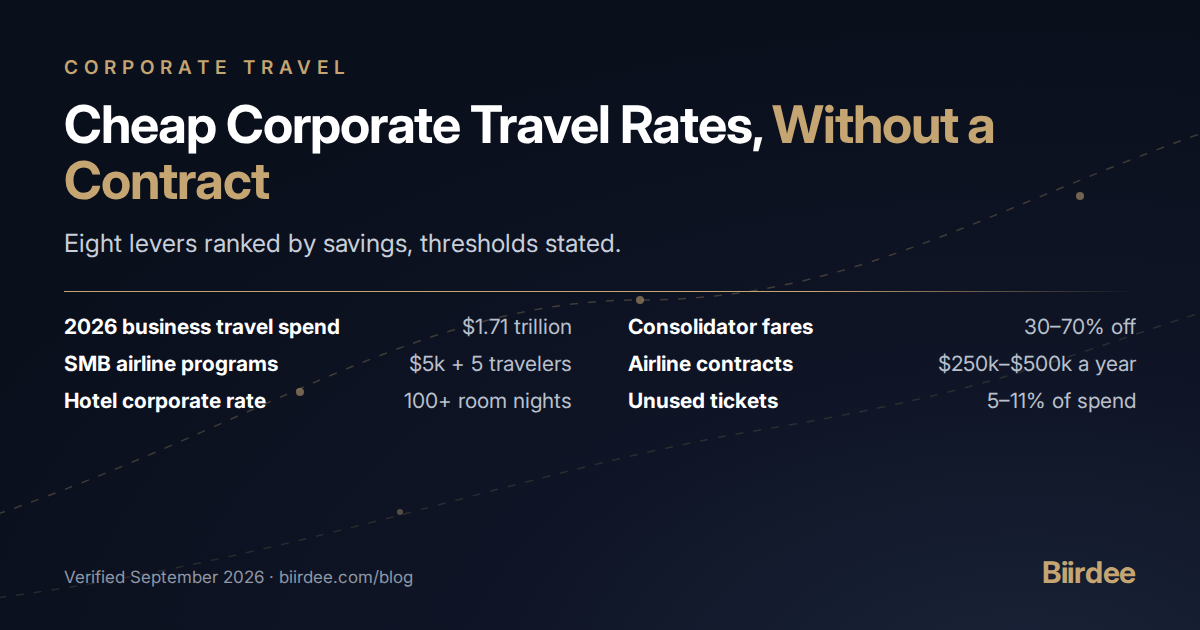
Most people who go looking for corporate travel rates are picturing something specific: a company code that takes 15 percent off every fare and a hotel rate that holds to the last room. Those exist. They are negotiated by companies spending hundreds of thousands of dollars a year on one airline and booking hundreds of room nights in one city, and for everyone else they are a story. This post is about what actually lowers the bill for the other 95 percent of companies, from a two-founder startup to a firm with fifty travelers.
The levers are ranked by how much they save, with the thresholds and the catches stated, as of September 2026. The context matters: the Global Business Travel Association forecasts global business travel spending at a record $1.71 trillion in 2026, up 7.2 percent, with trip counts rising only 1.3 percent. Prices are rising faster than travel is, and the trips being taken are longer and more selective. That is where the money goes, and that is where the savings are.
First, Where the Money Actually Goes
Before negotiating anything, look at last quarter's spend by trip. In most companies with any international travel, a handful of long-haul business and first class tickets outweighs hundreds of domestic economy bookings. A single published business class round trip between the US and Asia runs roughly $5,500 to $10,000 as of 2026; the same money buys twenty domestic economy trips. Levers that shave ten percent off the economy long tail are worth less than levers that cut a third off the premium head, which is why the ranking below starts where it does.
Lever 1: Consolidator Fares on Premium Cabins (No Buyer Volume Needed)
The largest structural discount in corporate travel is not negotiated by the company at all. Airlines distribute unsold premium-cabin inventory through private contracts with accredited agencies, at fares below the published price, and those fares never appear in a booking portal or on Google Flights.
- How it works. The airline grants a licensed agency net rates on specific cabins and routes in exchange for volume commitments. The agency resells the seat with its margin inside the discounted price. Same aircraft, same seat, same ticket stock, verifiable on the airline's website the day it is paid for. The full mechanics are in unpublished business class fares.
- Who can use it. Any company, at any size, through a specialist desk. There is no volume threshold on the buyer side because the volume commitment sits with the agency. This is what makes it the one lever a startup and an enterprise use identically.
- The catch. Contracted fares carry tighter rules than flexible published fares: change fees plus fare difference, restricted refunds, sometimes reduced mileage earning, and changes run through the agency rather than the airline's app. A desk worth using states those terms in writing before you pay. If a traveler's plans are genuinely volatile, a flexible published fare can be the better buy, and the desk should say so.
- What it does not cover. US domestic and economy tickets, where availability through these channels is limited to none. Keep those on the portal or book direct.
Lever 2: The Free Airline Small-Business Programs (Points and Perks, Not Deep Discounts)
The US carriers run free loyalty programs for companies that are too small for a contract. They do not cut fares; they pay the company points and perks on top of what travelers earn personally. Enrol in all of them; they stack with everything else. Terms as of September 2026:
- Delta SkyBonus. Free. For small and mid-sized companies with at least $5,000 in eligible flight revenue and five unique employee travelers a year. Employees keep earning their own SkyMiles.
- United PerksPlus. Free. Requires at least five employee travelers and a valid tax ID; $5,000 of spend on eligible carriers within 12 months keeps the membership renewing. Earns on United, United Express and partners including ANA and the Lufthansa Group airlines.
- American AAdvantage Business. Replacing the old Business Extra program. No minimum to register for a US or Canadian business with a federal employer identification number; the full set of perks needs $5,000 in eligible flown revenue plus five registered travelers, or the co-branded Citi business card.
Treat these as a rebate of a few percent, paid in points, not as a rate. They are worth the ten minutes of enrolment and not worth routing a traveler onto a worse itinerary to earn.
Lever 3: Negotiated Airline Contracts (Worth It Above a Threshold You Probably Do Not Meet)
The corporate discount people imagine. The honest numbers:
- The threshold. The legacy carriers generally look for something like $250,000 to $500,000 of annual spend on one airline before negotiating a tailored agreement. Air Canada cut its floor to $50,000 of eligible spend across Air Canada, United and the Lufthansa Group, effective 15 September 2026, down from roughly $250,000, which signals where the market is heading but is not yet the norm.
- The route deal. If your spend is small but concentrated, a hundred or more flights a year between the same two cities, an airline may offer a route-specific discount without a full contract. Ask.
- What you get. A percentage off published fares in specified booking classes, usually modest, with reporting obligations and sometimes a market-share commitment. On premium cabins the contracted discount from a consolidator fare usually beats it by a wide margin, which is why companies with contracts still route their long-haul premium trips through a desk.
- When it is not worth it. Below roughly a thousand flight segments a year, the negotiation effort and the lock-in tend to outweigh the discount. Spend the time on levers one and four instead.
Lever 4: Hotel Rates, at Three Sizes of Company
Hotels negotiate on room nights per property, not on total spend, so the thresholds are local.
- Negotiated corporate rates. As a rule of thumb, around 100 room nights a year at one property gets a conversation; many hotels want 150 to 250 or more, and in New York the ask can be 500. Last-room availability, the clause that makes the rate hold when the hotel is nearly full, typically costs one to two percentage points of discount. Attrition clauses set the room nights you must actually produce, commonly 70 to 90 percent of the projection, with fees or renegotiation if you fall short.
- Chain small-business programs. The major chains run free programs for small companies that give a modest discount or points without a room-night commitment. Like the airline programs, worth enrolling in and not worth designing a trip around.
- Preferred-partner rates for the executive tier. At luxury brands, rate parity is strict and no channel prices below the hotel's own site. What an advisor's preferred-partner program adds at the same rate is upgrade priority, breakfast and a property credit, paid for by the hotel. For an executive staying at that tier, that is the corporate rate. The two-tier truth is explained in how to book luxury hotels for less.
Lever 5: Timing and Construction
Free, and worth more than most people expect on long-haul premium. A desk applies these by default; a portal applies none of them.
- Book long-haul premium two to five months out. Four to six for peak windows like the December holidays. Private-channel fares regularly beat last-minute published pricing, so a late request is never hopeless, but the best inventory is not last-minute.
- Price it as one-ways and across carriers. Two one-ways on different airlines frequently beat one round trip, and the flexibility on the return is worth having for a business trip whose end date moves.
- Mixed cabins. Economy on the two-hour feeder leg, business on the overnight crossing. Nobody sleeps on the feeder. The saving is real and the traveler does not notice the difference where it matters.
- Off-peak dates. Late January through March and November outside holidays price well below midsummer on most long-haul routes. When a meeting date has a week of give, use it.
Lever 6: Stop the Leakage
Industry estimates put 5 to 11 percent of corporate air spend into unused tickets and expired credits. That is a larger number than most negotiated discounts.
- Track every credit with its expiry and its name. Airline credits are usually tied to the original traveler and expire on a clock. A spreadsheet is enough for a small company; a desk that holds the file does it for you.
- Know the reissue rules before you cancel. Whether a ticket can be changed, refunded or reused depends on the fare rules stated at purchase. On contracted fares the desk handles the reissue; on published fares the airline's app does. Either way, the rule was knowable on day one.
- Handle changes through one channel. Changes made by three different people in three different places are how credits get lost. One thread per trip, one owner.
Lever 7: A Policy That Saves Money Rather Than Just Restricting It
Four rules that lower cost without producing exhausted executives.
- Cabin by flight length, not by title. Business class above a stated block time (six hours is a common line, overnight flights regardless of length is another), economy or premium economy below it, for everyone. The rule is easy to enforce and it puts the premium money where it changes performance.
- A routing rule for anything premium or over a set price. "Anything long-haul or above $2,000 goes to the desk" captures nearly all the savings from lever one with one sentence.
- Arrival buffers. The cheapest itinerary that arrives ninety minutes before a board meeting is the most expensive itinerary when the connection fails. Require a buffer and price within it.
- Name the approver. Options expire in hours on contracted fares. A trip that waits three days for sign-off is repriced. Decide who can say yes, and let them say it quickly.
Lever 8: Pay With the Right Instrument
- Card versus bank transfer. Cards preserve chargeback protection, which is the right default with any new supplier. Above about $10,000 a bank transfer avoids card processing fees; Biirdee recommends it at that level and accepts both, along with Zelle and cryptocurrency.
- Company points. Transferable points from business cards can cover part or all of a premium booking on some routes and dates, and a desk that prices cash against points will tell you when the award wins. Points are transferred only after the seat is confirmed, never speculatively.
- Documentation. Itemized invoices per trip, in the format the finance team wants, agreed before the first booking. It costs nothing and saves the quarterly reconciliation argument.
What "Cheap" Should Not Mean
The cheapest corporate travel policy is not the one with the lowest fares. An executive who lands in London after eleven hours upright and negotiates badly that afternoon cost the company far more than the difference between economy and a discounted business class seat. The point of the levers above is to buy the front of the plane for closer to the price of the back, not to push everyone to the back. Wholesale premium is the corporate rate that actually exists for companies without a contract.
Where a specialist desk fits, and where it does not, is on our corporate travel page. The honest summary: for a team whose spend concentrates in long-haul premium cabins, a desk usually beats every other lever combined; for a company with hundreds of domestic economy travelers, a booking platform is the right backbone and the desk is a supplement for the trips it handles worst. Why those desks still exist at all, and how to get one, is in corporate travel agents still exist.
Frequently Asked Questions
- How do companies get cheap business class flights? The biggest lever is consolidator inventory: fares below published prices that airlines distribute through accredited agencies and that never appear in booking portals. It works at any company size because the volume commitment sits with the agency, not the buyer.
- How much do you need to spend to get corporate airline rates? For a negotiated contract with a legacy carrier, generally on the order of $250,000 to $500,000 a year on that airline as of 2026, with Air Canada's new $50,000 floor an early exception. Below that, the free small-business programs (Delta SkyBonus, United PerksPlus, AAdvantage Business) pay points at $5,000 of spend and five travelers.
- How many room nights do you need for a corporate hotel rate? Roughly 100 a year at one property to open a conversation; many hotels want 150 to 250 or more, and in the busiest markets up to 500. Last-room availability costs one to two points of discount.
- Are corporate discounts better than consolidator fares? On premium long-haul cabins, rarely. A corporate contract takes a modest percentage off published fares in specified booking classes; a consolidator fare on the same cabin usually beats it. Companies with contracts still route premium trips through a desk for that reason.
- What is the cheapest way for a small business to book travel? Enrol in the free airline and hotel small-business programs, keep domestic economy self-serve, route anything long-haul or premium through a specialist desk, track credits, and write a cabin-by-flight-length policy. Together those capture most of what a large program achieves without the volume.
Thresholds, fees and program terms in this post were checked in September 2026 and will change; confirm the current terms before relying on them.
Biirdee · Flight Concierge
Bring Us Last Quarter's Premium-Cabin Spend
Send an upcoming route and what the same trip cost last time. We price it across every channel and show the comparison in writing; if the number is not meaningfully better, you have lost thirty minutes.
Questions?[email protected]
Prefer to book it yourself at net fares?
Biirdee Pro members book flights & hotels at net rates: $100/mo, cancel anytime.
Keep reading