Yes, Corporate Travel Agents Still Exist (and Why Your Booking Portal Is Not One)
The human did not disappear when your company rolled out a portal. They moved behind it, at $25 a call, or to specialist desks that handle the trips a portal handles worst. Here is how to get one.
By Biirdee Team · September 16, 2026
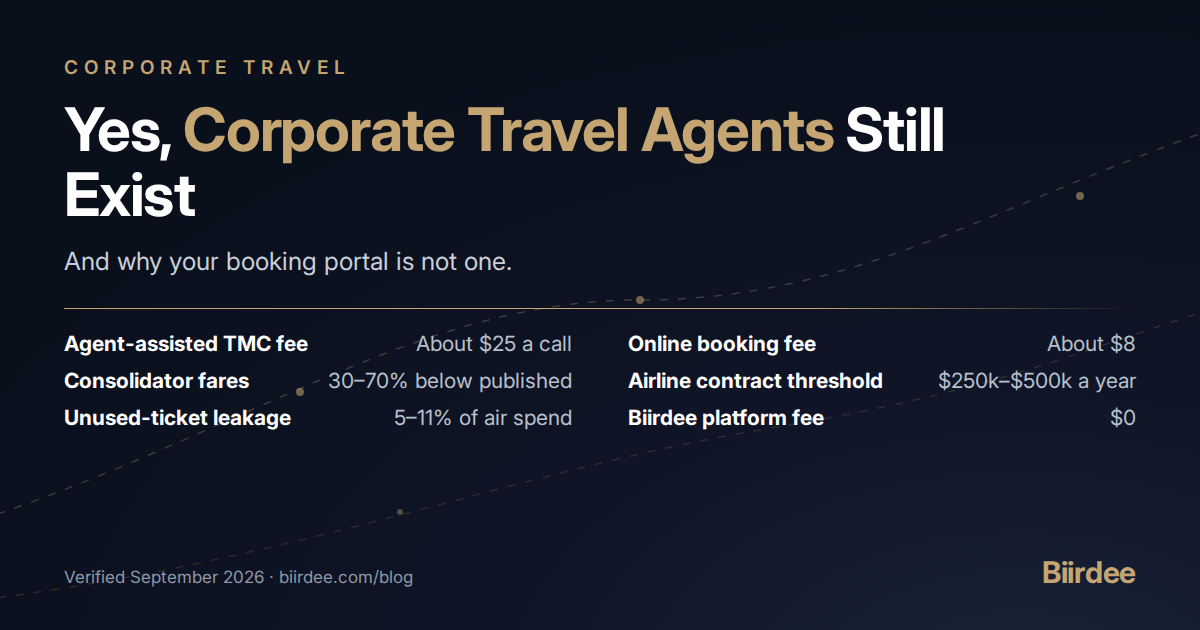
People ask whether corporate travel agents still exist because the last time they booked a work trip, no human was involved. The company rolled out a portal, the portal offered a policy-compliant fare, and the trip happened. So where did the agent go? Two places. Behind the portal, where the travel management company that runs it still employs agents you reach by phone, for a fee per call. And to specialist desks, which handle the part of corporate travel that portals price and service worst: long-haul premium cabins, complex itineraries, and the trips where something goes wrong.
This post is for the person who suspects the portal is costing them more than it saves. It explains what a corporate travel agent actually is in 2026, what portals do genuinely well, where they fall down on price, flexibility and service, and how a company gets a human desk without abandoning the tooling it already has. Figures are current as of September 2026 and will change.
What a Corporate Travel Agent Is Now
A corporate travel agent is a person who prices, books and services business travel on behalf of a company and its travelers, holding the traveler's file from quote to return. Three versions exist today.
- The agent behind the portal. Every large travel management company, including the ones whose software front end you know by name, keeps agents on staff. You reach them by phone or chat when the portal cannot do what you need. Industry benchmarks put the fee for an agent-assisted transaction around $25, against roughly $8 for an online one.
- The specialist desk. An accredited agency that holds airline consolidator contracts and hotel partner programs, working with a company's executives and assistants through one channel. It handles the premium long-haul, the multi-city roadshow, the last-minute board meeting, and the disruption at midnight. Biirdee's corporate travel desk is this kind.
- The executive assistant's own desk. Many executive assistants run the travel of one or several principals themselves and use a specialist desk as an extension of their own, handing off pricing and servicing while keeping the brief and the approvals. That arrangement has its own page: Biirdee for executive assistants.
What Portals Do Well
Be fair to the software. Navan, TravelPerk, SAP Concur, Egencia (part of Amex GBT since 2021) and their competitors solve real problems, and for some companies they are the right tool.
- Policy and approvals. A cabin rule by flight length, a nightly hotel cap by city, an approval chain. The portal enforces it automatically, which no human desk can do at scale for hundreds of travelers.
- Expense integration. The booking becomes the expense line. For a finance team reconciling thousands of trips, this alone justifies the platform.
- Duty of care. Knowing where every traveler is during an incident is a legal and moral obligation for large employers, and portals do it well.
- Self-serve economy bookings. A domestic economy round trip does not need a human. A portal prices it in seconds at close to the published fare, and that is fine.
- Reporting. Spend by department, by route, by supplier, in a dashboard. Necessary for negotiating anything, and for the annual budget conversation.
If your company has hundreds of travelers, most of them flying domestic economy, and a finance team that needs policy and reporting, a portal is the correct backbone. Nothing below argues otherwise.
Where Portals Fall Down
The portal's weaknesses cluster in exactly the trips that dominate a company's spend when its people fly long-haul in the front of the plane.
- Price on premium cabins. A portal sells published fares, sometimes with a negotiated corporate discount on top. Those discounts require volume most companies do not have: the legacy carriers generally want on the order of $250,000 to $500,000 a year on one airline before they negotiate a contract, although Air Canada's September 2026 move to a $50,000 floor for agreements spanning Air Canada, United and Lufthansa Group shows the direction. Even with a contract, the discount is a modest cut from the published fare. Airlines distribute their premium-cabin discounts through private consolidator contracts instead, priced below the published fare, and those fares are invisible to portals by design. The mechanism is in unpublished business class fares.
- Flexibility on complex trips. A three-city investor roadshow across two alliances with an open jaw at the end is not a portal search; it is a construction problem, priced leg by leg. Portals return whatever the fare engines combine automatically, which is rarely the cheapest or the sanest routing.
- Service when something breaks. At 11 p.m. at the gate, the portal offers a seat 31 hours later and a support queue. The agent behind it costs a fee per call and does not hold your traveler's file. A desk that does hold the file knows the fare rules, the partner airlines it can reprotect onto, and the hotel to warn.
- The fee stack. Per-transaction fees (roughly $8 online, $25 by phone, more for changes), platform subscriptions, and in some models a percentage of spend. Small individually. On a trip that needs three changes, not small.
- Unused ticket leakage. Industry estimates put 5 to 11 percent of corporate air spend into tickets that go unused or whose credits expire untracked. Portals report the credits; someone still has to use them, and the reissue rules on the fare decide whether they can be.
Why "Nothing Compares to a Human" Is Not Nostalgia
It is tempting to read the case for a human agent as sentiment. It is arithmetic. A specialist desk does three things software does not. It prices one trip across every channel: contracted fares by carrier, the published sales, one-way and mixed-carrier constructions, mixed-cabin routings, and award inventory if the traveler holds points, then returns two or three options with the trade-offs in writing. It exercises judgment: the connection that looks fine on a screen and strands people in practice, the fare rule that will matter in three weeks, the airport the executive should not be routed through. And it owns the booking after ticketing: seats, status numbers, lounge access, changes, and the reprotection at midnight, in one thread, by a person who already knows the traveler.
Our post on what a travel concierge actually does walks through the mechanics for individuals. For a company the same mechanics apply, with two additions: the traveler profile is kept on file so repeat bookings take one message, and billing and documentation are set up per engagement to match what the finance team needs.
How to Get a Corporate Travel Agent
Six steps, none of which require ripping out the portal.
- Decide which spend you are routing. Usually: long-haul business and first, executive and founder travel, roadshows and delegations, and anything last-minute. Leave domestic economy on the portal.
- Look for accreditation. A desk that sells airline tickets holds ARC accreditation in the US or IATA elsewhere, and can produce the number. Registered sellers of travel publish their registration; Biirdee Inc. is a registered California Seller of Travel, CST 2138352.
- Ask how it is paid. Fare spread, commission, fees or a retainer. The answer should take one sentence. Biirdee earns inside the discounted fare, with no platform fee, seat fee or minimum team size; our pricing page says so and invites the checks.
- Ask what happens at 2 a.m. Specifically: who answers, whether they hold the file, and whether changes on contracted fares run through the desk (they do, and that is the honest trade-off against the airline's own app).
- Run a bake-off on a real trip. Send an upcoming itinerary and what you paid for the same route last time. If the number is not meaningfully better, you have lost thirty minutes. This is the entire pitch, and any desk worth using will accept it.
- Settle the paperwork before the first booking. Invoicing, card versus bank transfer, itemized documentation, traveler profiles and who may approve. A good desk asks these questions first; a consultation is the usual place to settle them.
The Hybrid Most Companies End Up With
The realistic model for most mid-sized companies is a portal for the long tail and a desk for the head of the spend. The portal keeps policy, expense and reporting for the hundreds of ordinary trips. The desk takes the dozen long-haul premium itineraries a quarter where the price gap is thousands per ticket and the service gap is a stranded executive. Biirdee's corporate travel page lays out the fit honestly, including the cases where an enterprise travel management platform is the better tool.
For small companies and founders, the desk is often the whole answer: a single WhatsApp thread for every traveler, booking and change, invoices per engagement, and no platform to administer. Executive assistants run the same arrangement on behalf of their principals; the executive assistant's guide to booking executive travel covers how.
Frequently Asked Questions
- Do corporate travel agents still exist? Yes. They work behind the booking portals at travel management companies, reached by phone for a per-call fee, and at specialist desks that handle premium long-haul, complex and last-minute corporate trips through one human channel.
- What does a corporate travel agent do? Prices business trips across contracted, published and award channels, books them, keeps traveler profiles, handles changes and disruptions, and arranges invoicing and documentation for the company. The difference from a portal is judgment and ownership of the booking after ticketing.
- Is a corporate travel agent cheaper than a booking portal? On long-haul business and first class, usually: a specialist desk prices against consolidator fares that sit below the published price and that portals cannot see. On domestic economy, no; the portal is the right tool and an honest desk says so.
- Can a small company use a corporate travel agent? Yes. Biirdee has no minimum team size, platform fee or contract; some clients are a single founder flying monthly. The desk earns inside the fares it books.
- How do I switch from a portal to an agent? You usually do not switch; you add. Keep the portal for the long tail and route the premium, complex and last-minute trips to the desk. Start with a bake-off on one real itinerary against your last invoice.
Fees, thresholds and program terms in this post were checked in September 2026 and will change.
Biirdee · Flight Concierge
Price One Real Trip Against Your Last Invoice
Send an upcoming itinerary and what the same route cost last time. A real agent prices it across every channel and comes back with options, the fare rules and the all-in price in writing.
Questions?[email protected]
Prefer to book it yourself at net fares?
Biirdee Pro members book flights & hotels at net rates: $100/mo, cancel anytime.