Sabbatical Travel Planning: How to Spend Three Months Away Without Wasting Them
A three-month trip and three separate one-month trips cost about the same. Only one of them resets you, and the difference is structure rather than budget.
By Biirdee Team · September 11, 2026
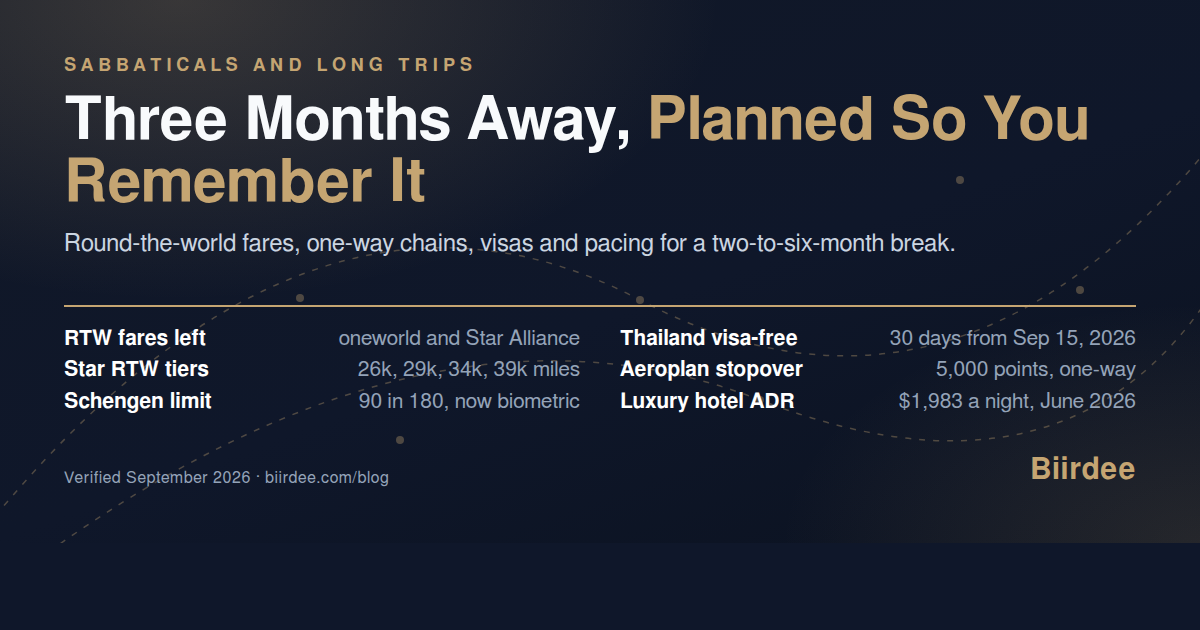
A three-month trip and three separate one-month trips cost about the same. Only one of them resets you. The difference is not budget. It is structure: how many beds you sleep in, how many airports you pass through, and how much of the calendar you leave undecided on purpose.
This is a planning guide for two to six months away, written for the reader whose tender offer or IPO has cleared and who is finally taking the break. Rules and prices are current as of September 2026 and will change, so treat every figure as a benchmark to check rather than a quote. If you are still in the first weeks after the money landed, our post on how to travel after a liquidity event covers the shorter horizon.
Start With the Shape, Not the Route
The first decision is not where. It is how many bases. Sabbaticals fail predictably: fourteen countries, forty beds, and a camera roll you cannot tell apart by week six. The ones that work have three or four anchors and blank space between them.
For ninety days, three anchor stays of two to four weeks each, separated by short transit weeks, is the shape that holds. Then apply the two constraints that are not yours to negotiate. Visas cap how long you can sit still. Seasons cap when a place is worth sitting in. Everything else, the fare included, bends around those two.
Round-the-World Fares: What Is Left in 2026
Alliance round-the-world fares are still a good product, and fewer people qualify for them every year. SkyTeam retired its program following a 2023 decision, citing a shift in traveler preference toward point-to-point travel. Two are left.
The mechanism explains the rules. An alliance discounts the whole journey because it wants all of it, so it prices by continents crossed or total miles flown rather than by market, then fences the fare with routing rules so you cannot arbitrage the cheap zones.
As of September 2026:
- oneworld Explorer. Priced by cabin, by the number of continents you visit, three to six, and by the country where the journey starts. The fare rule allows three to sixteen segments including surface sectors, though Upgraded Points describes the cap as fifteen. Travel runs one direction and the ticket is valid ten days to twelve months. That guide prices economy at 3,599 dollars for three continents, rising to 6,899 for six.
- Star Alliance Round the World. Priced by total mileage in four tiers, 26,000, 29,000, 34,000 and 39,000 miles, plus origin country and cabin. Two to fifteen stopovers, counting any stay over 24 hours, no more than three per country and one per city. Exactly one transatlantic and one transpacific crossing, and in First or Business at least ten days between the first and last intercontinental sector.
- Origin moves the price more than routing does. We found no published US-dollar business fare originating in America. Australian sellers list oneworld business from about 13,800 Australian dollars including taxes and Star Alliance business from roughly 14,950 to 18,750 by tier, though the currency is inferred rather than stated. Thrifty Nomads reports the same seven-segment business itinerary at 13,056 dollars from Los Angeles and 7,811 from Johannesburg.
- The family math is worse than you expect. Star Alliance child fares for ages two to eleven are 75 percent of the adult fare, but that discount does not apply in First or Business, and children must fly in the same cabin as a full-fare adult. Two adults and two children is four business fares.
An alliance fare rewards someone who will genuinely fly ten or more sectors in one direction inside twelve months. If your plan is three long stays and four flights, you are buying rules you will never use.
The Case for a Chain of One-Ways
The alternative is to buy the trip one leg at a time, in the front cabin, with a mix of cash and points. Per mile it usually costs more. It buys the one thing a round-the-world cannot: the right to change your mind in month two. Expect attrition in the tools, though. ANA stopped issuing new Star Alliance round-the-world awards on June 24, 2025, and United removed the Excursionist Perk from August 21, 2025.
What the chain looks like in practice:
- Cash one-ways are expensive but knowable. Simple Flying reported in 2026 that a one-way American Flagship Business fare across the Pacific generally sits near 3,100 dollars and can exceed 8,500, with most US to Asia business fares between 4,000 and over 10,000. Average transatlantic business fares regularly exceed 3,500.
- Aeroplan is the most flexible chain-builder left. Air Canada adds a stopover to any one-way award for 5,000 points, one per direction, except wholly within North America, and that survived the June 1, 2026 chart changes. Those changes moved North America to Europe business in the 4,001 to 6,000 mile band from 70,000 to 75,000 points, and partner business to East Asia in the 7,501 to 11,000 mile band from 87,500 to 102,500. Our Aeroplan guide walks through it.
- Asia Miles is the closest surviving thing to an award round-the-world. Cathay's oneworld multi-carrier chart permits up to five stopovers, two transfers and two open jaws on an itinerary of up to 50,000 miles that ends where it started, and Cathay left it unchanged in its May 2026 update. Our Asia Miles guide has the chart.
Stopovers Are the Cheapest Second Country You Can Buy
A stopover is the one place in this plan where the airline pays for your detour. Hub carriers want your connecting traffic, so they let you break the journey for days or weeks at no extra miles. On a three-month trip with four long-haul legs, that is up to four extra cities for nothing.
Three programs make it easy. Alaska's Atmos Rewards allows one free stopover of over 24 hours on most one-way international partner awards and two on round-trips, with a 20-dollar partner-award booking fee per person each way from July 1, 2026. Flying Blue allows a free stopover of 24 hours to one year including on one-ways, but every segment must be operated by the same airline to price as one award. KrisFlyer gives one complimentary stopover of up to 30 days on round-trip Saver awards on its own flights, and none on one-way Saver, though one can be added for 100 US dollars.
Our post on free stopovers covers the eight airlines that add an extra country, and sometimes a free hotel night, to a ticket you were buying anyway. Build one into each long-haul and the transit weeks stop being transit.
Visas Decide Your Calendar More Than Weather Does
This is the constraint most people meet late, usually after they have paid for a villa. The 90-days-in-any-180 Schengen limit is no longer a stamp somebody might miscount: the EU Entry/Exit System phased in from October 12, 2025 and became fully operational on April 10, 2026, replacing stamps with biometric records counted across the whole area.
As of September 2026:
- Europe is one 90-day pool, not four. Days in Portugal, Spain, Italy and Greece all draw down the same allowance, and a national long-stay visa is the only way past it. ETIAS, when it arrives, will cost 20 euros for travelers aged 18 to 70 and last three years. The EU dropped its late-2026 target in July 2026 and 2027 is now the likely launch.
- The long-stay visas, by income test. Portugal's D8 requires gross monthly income of 3,680 euros in 2026. Spain's requires 2,849 euros a month, Italy's 28,000 euros a year, and Greece's 3,500 euros a month plus, since February 2026, a consulate application before you travel.
- Japan: 90 days visa-free, six months with paperwork. US passports enter visa-free for 90 days. The digital nomad visa runs up to six months with no extension, requires annual income of 10 million yen and private medical insurance of at least 10 million yen, and admits a spouse and unmarried children under 18.
- Thailand got shorter on September 15, 2026. Visa-exempt stay dropped from 60 days to 30 for nationals of 60 countries including the US, UK, Canada and Australia. The Destination Thailand Visa is the alternative: five years, 180 days per entry, a 10,000 baht fee, and proof of 500,000 baht held for three months.
- The rest of the usual list. Indonesia's visa on arrival gives 30 days, extendable once to 60. Mexico admits tourists for up to 180 days, but the number is the officer's and a border run does not reset it. Australia's ETA allows three months per entry. New Zealand has allowed remote work for an overseas employer on visitor visas since January 27, 2025.
- The 183-day line is a tax question, not a travel one. Spending 183 days or more in a calendar year in Portugal or Spain generally triggers tax residency on worldwide income, and a digital nomad visa does not change that. A ninety-day trip split across countries is nowhere near it. A six-month stay in one country is. Ask your tax advisor before you sign a lease, not after.
Pace It: Two Slow Weeks for Every Fast One
The mechanics that make ninety days feel long rather than blurred:
- Anchor, then move. Two to four weeks in one place, then a short transit week, then the next anchor. Monthly villa rates generally run 50 to 70 percent below the nightly rate for the same property, so the slow weeks are also the cheap ones. A three-bedroom luxury villa in Seminyak runs 3,500 to 6,000 dollars a month.
- One long-haul a month, one week unbooked. Every crossing costs two or three days on each side, so four long-hauls in ninety days is already a full schedule. Leave a week a month unassigned. That is where a trip stops being an itinerary.
- If you are still working, build around the calendar, not the map. Pick time zones your team can reach and schedule the flying for weeks you were never going to be useful anyway. Our post on working from 40,000 feet goes deeper.
- With a partner, book separate mornings. Three months is long enough that every waking hour together becomes the thing you remember, and not fondly. One activity a week you each do alone is usually enough.
- With kids, worldschooling is legally homeschooling. It is legal in all fifty states, but withdrawal rules vary and some require formal notice. Independent study contracts typically cover only five to fourteen or five to twenty school days, so a multi-month trip generally means formal withdrawal.
- Chase shoulder seasons. Japan's best-value months are May and October to November; cherry blossom season runs hotel prices 30 to 60 percent above February. Mainland Southeast Asia is driest November to February while Bali is dry April to October. Europe's shoulders are late April to May and mid-September to October.
A Ninety-Day Itinerary, Built the Way We Would Build It
Departing San Francisco in early October and moving west. Not a template to copy, but a demonstration of how the pacing and the rules interact.
- Weeks 1 to 3: Japan, one base. October and November are Japan's best-value months alongside May. One apartment or hotel in Kyoto or Tokyo, day trips out, no internal moves. Budget one guided day: a licensed private guide in Tokyo runs 60,000 to 80,000 yen for a full day in 2026, a chauffeured premium day 100,000 to 200,000. Our Aman Japan guide is a place to start.
- Weeks 4 to 8: mainland Southeast Asia. November is the front of the dry season. Since September 15, 2026 the Thai visa-exempt stay is 30 days, so five weeks here means either a Destination Thailand Visa or a split with Vietnam or Cambodia. Bangkok is the natural hub, and our guide to the best luxury hotels in Bangkok is where we would begin.
- Week 9: the stopover you did not pay for. Singapore or Hong Kong, built into the award ticket rather than bought as a separate leg. A week, not a night.
- Weeks 10 to 12: Australia or New Zealand. The southern shoulder runs September to November and again March to May, so late November lands you ahead of summer rates. New Zealand allows remote work for an overseas employer on a visitor visa, which matters if the trip has quietly become a working one.
- The count. Four long-hauls, three anchors, one stopover week bought with points you were spending anyway, and one week left unassigned.
Health, Mail and the Admin That Ends Trips Early
The unglamorous half, and the half that actually ends trips early:
- Medicare stops at the border. Medicare does not cover care outside the United States. Medigap's foreign travel emergency benefit is capped at a 50,000 dollar lifetime limit, pays 80 percent after a 250 dollar deductible, and applies only to the first 60 days of a trip. A medical evacuation home can cost 25,000 to 250,000 dollars.
- Entry-level cover is cheap, and it is a floor. SafetyWing's Nomad Insurance Essential runs 56.28 dollars per four weeks for ages 10 to 39, 92.40 for 40 to 49, 145.04 for 50 to 59 and 196.84 for 60 to 69. It is travel-medical cover, not health insurance.
- Passports. Much of Asia requires six months of validity beyond entry, and airlines enforce it even where a destination is lenient. Routine US processing was four to six weeks as of May 2026, or two to three weeks expedited for a 60 dollar fee.
- Mail and money. USPS Hold Mail is free but capped at 30 days; Premium Forwarding Service Residential ships weekly for 21.10 dollars a week plus a 21.10 enrollment fee. Schwab Bank Investor Checking charges no monthly fee, no foreign transaction fees, and rebates ATM operator fees worldwide.
- Who knows where you are. A long trip widens your exposure in ways a week in Paris does not. Our post on travel privacy and security covers what to change first.
What Ninety Days Actually Costs
Lodging is the swing factor and the range is enormous. Virtuoso's average preferred-hotel rate reached 1,983 dollars a night in June 2026, up 11.2 percent year over year, against 1,632 in January. Aman entry rates start around 1,200 to 3,200 dollars or more a night in 2026, while Four Seasons entry rates run roughly 600 to 1,500.
Ninety nights at the Virtuoso average is about 178,000 dollars in rooms alone. Swap two of those months for monthly-rate villas, at the 50 to 70 percent discount long rentals carry, and the total moves more than any fare decision will. Flights are the smaller line and the one people over-optimize. Decide the shape first, price it second. Our post on where to stay after the exit compares the three formats.
Build the Plan So It Can Change
Book the first long-haul, the first anchor, and nothing else that carries a penalty. Scarcity is the only reason to commit early: a specific front-cabin seat on a specific date, or a villa in a two-week window that has three of them. The rest can be decided from a hotel room in Kyoto with better information than you have now.
One honest footnote. The business and first class fares we broker at Biirdee typically price below published, but their rules are tighter than the flexible fares they undercut: expect change fees, restricted refundability, sometimes reduced mileage earning, all stated in writing before you pay. Changes run through our desk rather than the airline's app. On a trip that will change twice, that is a trade, not a free lunch.
It is also why we price a long trip leg by leg instead of as one ticket. A leg at a time gives us more strategies to work with, and it keeps month three open while month one is already ticketed. Quotes come back in 30 to 60 minutes in most cases and always within 24 hours, with no booking fees.
Frequently Asked Questions
- Is a round-the-world fare cheaper than separate tickets? Usually, if you actually fly the segments. Thrifty Nomads' 2026 guide argues a well-built round-the-world can undercut a single premium return by 30 to 50 percent, and that stitched one-ways are almost never cheaper in business class. The catch is committing the skeleton in advance.
- Can I still book a round-the-world on points? Not the way you could two years ago. ANA discontinued new Star Alliance round-the-world awards on June 24, 2025 and United ended the Excursionist Perk on August 21, 2025. The closest survivor is Cathay's oneworld multi-carrier award: up to five stopovers on an itinerary of up to 50,000 miles. Our post on using airline miles well covers the alternatives.
- How long can I stay in Europe? Ninety days in any 180 across the whole Schengen area, and since April 10, 2026 that count is biometric. Longer in one country means a national long-stay visa with an income test: 3,680 euros a month for Portugal, 2,849 for Spain, 28,000 a year for Italy, 3,500 a month for Greece.
- How many countries should three months cover? Three or four, with two to four weeks in each. Airlines and visas will happily let you do more. The trips people describe as restorative afterwards almost never do.
Charts, fees, and program rules in this post were verified in September 2026 and will change. Confirm the current figure with the program before you book.
Biirdee · Flight Concierge
Tell Us the Three Months
Tell us roughly when you want to leave, how long you have, and the two or three places you already know you want. We will come back with the fare structures that fit, the visa and season rules that would break the plan, and whether a round-the-world, a chain of premium one-ways, or your points get you there for less.
Questions?[email protected]
Prefer to book it yourself at net fares?
Biirdee Pro members book flights & hotels at net rates: $100/mo, cancel anytime.
Keep reading