Tech Tender Offers, IPOs and Secondary Sales in 2026: The Facts, Company by Company
What a tender offer is, which companies ran them, and what actually lands in a bank account after caps, lockups and withholding. Figures are current as of September 2026.
By Biirdee Team · September 11, 2026
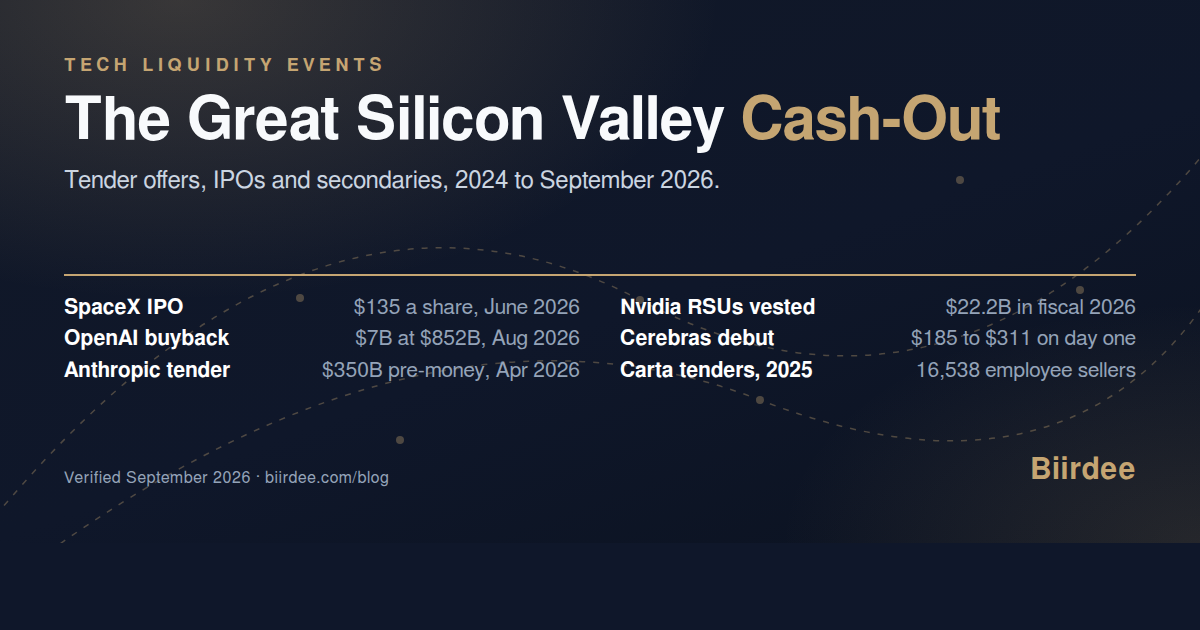
Between January 2024 and September 2026, tender offers became the standard way tech employees turned equity into cash. Carta, which administers equity for thousands of private companies, recorded its highest-ever annual total of employees selling in 2025. Much of this money never touched a public market. It came from those company-arranged windows in which staff sell vested shares to an outside buyer or back to the company itself.
This post is the factual base underneath that. What a tender offer is, which companies ran them and on what terms, what the public listings actually paid, and the mechanics that decide how much of a headline number reaches a checking account. Figures are attributed to their outlet and month wherever the source is a single report. Nothing here is tax, legal or investment advice, and several of the rules below are complicated enough that a CPA or a securities attorney is the only sensible next step.
Figures are current as of September 2026 and will change. Valuations move, lockups expire, and federal tax parameters reset every January. If you are already past the cap table and thinking about the calendar, our companion post on how to travel after a liquidity event picks up where this one stops.
Start With the Instrument: Five Terms
As of September 2026, five terms carry most of the weight in any liquidity conversation.
- Tender offer. A company-arranged window in which employees can sell vested shares. The offer documents set the price, the eligible participants, the maximum number of shares, the participation window and the conditions. The buyer may be the company itself, existing shareholders, or an outside investor the company designates. Nothing about it is automatic. You elect, and the company accepts or cuts back.
- Secondary sale. A sale of shares that already exist, from a holder to a buyer. No new capital reaches the company. From the employee's side a tender and a secondary feel identical. From the company's side they are different transactions, which is why a round gets described as primary, secondary, or a mix.
- Oversubscription and proration. If employees offer more shares than the buyer will take, the offer is oversubscribed and the company applies a proration method that reduces the number accepted from each participant. Planning around a published cap is optimistic. Planning around the wire that clears is not.
- IPO lockup. A contractual bar on selling for a set period after a listing, commonly around 180 days. It is the single most important date for a newly public employee, and as the SpaceX, Cerebras, CoreWeave and Figma schedules below show, the real date is frequently not 180 days.
- RSU. A restricted stock unit, a promise of shares that becomes real only at vesting. At vest the full fair market value becomes ordinary W-2 wages, and that value becomes the shares' cost basis. Holding vested shares afterward is economically the same as taking a cash bonus and buying employer stock with it.
Why Tender Offers Stopped Being Unusual
The mechanism is old. What changed is the cadence. Companies that would once have listed within seven or eight years now stay private past a decade, which leaves employees holding vested equity with no way to sell and, in some cases, restricted units approaching an expiry. Recurring tenders solved that, and in solving it they became retention infrastructure rather than a one-off event.
Carta, which administers equity for thousands of private companies, recorded 16,538 employees selling shares in tender offers during 2025, its highest annual total, with 20% of sellers being former employees. In the first half of 2026 it administered 71 tender offers worth roughly $3 billion, with transaction value up 200% year over year.
The intent is stated plainly by the companies themselves. When Databricks announced its $10 billion Series J at a $62 billion valuation in December 2024, it said proceeds would provide liquidity for current and former employees and pay related taxes, and Axios reported at the time that almost all of the raise was going to buy employee shares. Stripe has run a tender every February since 2024. Rippling's chief executive told Reuters in May 2025 that he expected its tender to become an annual event.
The Six That Set the Marks
Six companies did more than any others to set the price of tech equity in this window. Taken in order of scale, they show the same instrument producing very different outcomes.
SpaceX: Four Tenders, Then the Largest IPO Ever
SpaceX ran employee tenders roughly twice a year. Bloomberg reported the June 2024 offer at $112 a share, near a $210 billion valuation. December 2024 came at $185 a share and about $350 billion, with up to $1.25 billion purchased and SpaceX itself buying up to $500 million, per Bloomberg and CNBC. July 2025 was $212 a share at roughly $400 billion. In December 2025, CNBC and Bloomberg reported an insider sale of up to $2.56 billion at $421 a share and about $800 billion. None of it raised money for the company. All of it was existing holders selling.
A five-for-one split in May 2026 reset the per-share reference to roughly $105. SpaceX priced its IPO at $135 on June 11, 2026, opened at $150 the next morning and closed its first day at $160.95, per CNBC. The deal raised $75 billion at pricing and, after underwriters exercised the overallotment in full, about $86.25 billion gross and $85.7 billion net of underwriting and offering costs, the largest IPO in history. Fortune reported on June 11 that more than 4,000 employees became paper millionaires, from executives to welders.
Then the schedule took over. The lockup releases in tranches: up to 911.5 million shares became eligible on August 6, 2026, two trading days after the first quarterly report, with 7% tranches following at set intervals and the balance freeing around early December. Musk and certain major holders are restricted for 366 days. Over that stretch the stock hit an intraday high of $225.64 on June 16, fell below its IPO price in July, bottomed near $105 in early August and recovered to roughly $143 by month end. Which tranche an employee sat in mattered more than the IPO price did.
OpenAI: Four Windows and a $30 Million Ceiling
OpenAI ran four company-arranged windows. Bloomberg reported the first, a Thrive Capital-led tender completed in February 2024, at an $86 billion valuation, while Forbes and others put it above $80 billion. In November 2024, CNBC reported a roughly $1.5 billion tender with SoftBank as sole buyer at $210 a unit and a $157 billion valuation. Fortune reported that December that roughly 400 current and former employees were eligible, each able to sell up to $10 million, with every eligible person guaranteed at least $2 million.
October 2025 was the largest. Bloomberg and CNBC reported the completed sale at $6.6 billion and a $500 billion valuation. The Wall Street Journal later reported that more than 600 current and former employees sold and that about 75 hit the individual cap, which had been tripled from $10 million to $30 million. It was not oversubscribed: OpenAI had authorized up to $10.3 billion and used roughly two-thirds. In August 2026, Bloomberg reported a fourth window of about $7 billion, funded with OpenAI's own cash at an unchanged $852 billion valuation.
Two pieces of context matter for anyone doing per-person math. CNBC reported in June 2024 that OpenAI rewrote its rules so former employees participate on the same limits and timing as current staff. And the Wall Street Journal, as reported by Fortune in February 2026, found stock-based compensation averaged about $1.5 million per employee across roughly 4,000 staff in 2025. OpenAI filed confidentially for an IPO in June 2026, and CFO Sarah Friar told employees on August 19, 2026 that the company will be public in 2027, or sooner if the business inflects.
Anthropic: The Tender Employees Declined
Anthropic's first employee buyback came in May 2025. The Information reported the price at $56.09 a share, matching the $61.5 billion Series E, with employees of at least two years able to sell up to 20% of their holdings capped at $2 million each.
Nine months later the mark had moved by nearly a factor of six. Bloomberg reported in February 2026 that Anthropic launched a tender at roughly a $350 billion pre-money valuation, open to current and former employees with at least twelve months of tenure, with investors ready to buy $5 billion to $6 billion of stock. On April 8, 2026, Bloomberg reported the outcome: the offer completed, but employees held their shares and the sale fell short of what investors wanted. That is the inverse of the usual problem, and it is the clearest signal in this period that employees expected a higher mark later.
They had reason to. Anthropic raised $65 billion at a $965 billion post-money valuation in May 2026 and filed confidentially for an IPO on June 1. Reuters, via CNBC on September 5, 2026, reported the public prospectus slipping to late September with a roadshow no earlier than mid-October. The Information reported in August that the offering is expected to include a secondary component letting existing holders sell at the IPO, with lockups running well beyond 180 days, and reported in July that the company was weighing a requirement that rank-and-file employees sell only through preset Rule 10b5-1 plans. As of September 10, 2026, no public prospectus, price range or ticker had been filed.
Nvidia: The Public-Market Version of the Same Story
Nvidia has been listed since 1999, so none of the tender mechanics apply. Its employees get liquidity the ordinary way, in quarterly vesting tranches sold into an open market. The scale is the story. Nvidia's annual report discloses the fair value of restricted and performance units at vesting: $8.2 billion in fiscal 2024, $15.1 billion in fiscal 2025 and $22.2 billion in fiscal 2026, across a workforce of roughly 42,000 at the fiscal year ended January 25, 2026. A further $14.8 billion of unearned stock compensation remained, to be recognized over a weighted-average 2.3 years.
The backdrop is the market capitalization. Nvidia became the first company to touch $4 trillion intraday on July 9, 2025, closing that day at about $3.97 trillion, then the first worth $5 trillion on October 29, 2025, and reached $5.5 trillion on May 13, 2026, per CNBC and Forbes. The vesting disclosures above are audited and public, which is more than most of the private marks in this post can claim.
Nebius: Three Years Frozen, Then a Relisting
Nebius is the instructive case for anyone whose equity is stuck. Carved out of Yandex, its shares were halted on Nasdaq from February 28, 2022 and did not resume trading until October 21, 2024 under the ticker NBIS. For nearly three years, employee equity had no market at all.
After the relisting the numbers moved quickly. In December 2024 the company sold $700 million of stock at $21.00 a share to Accel, Nvidia and accounts managed by Orbis. In September 2025 it announced an AI-infrastructure agreement with Microsoft worth roughly $17.4 billion through 2031, expandable to about $19.4 billion, and the shares jumped about 50%. A Meta agreement worth roughly $2.9 billion followed in November. Nebius reported 1,543 employees at the end of 2025, with awards vesting over four years and the first tranche landing at the twelve-month mark. The stock was quoted at $232.80 on September 10, 2026 against a 52-week range of $73.52 to $299.86.
Cerebras: The Clearest Lesson in Timing
Cerebras filed to go public in September 2024. A national-security review of the stake held by G42, its largest customer, stalled the deal until March 2025, when the company limited G42 to non-voting shares. It withdrew the 2024 registration on October 3, 2025 anyway, with chief executive Andrew Feldman telling CNBC the prospectus was out of date. It raised privately instead: $1.1 billion at an $8.1 billion valuation in September 2025 at $36.23 a share, then $1 billion at $23 billion in February 2026 at $89.01.
It refiled on April 17, 2026, disclosing 708 employees as of December 31, 2025 and $510 million of 2025 revenue. The IPO priced at $185 on May 13, 2026, $25 above an already raised range, selling 30 million shares for $5.55 billion and about $6.38 billion gross once the overallotment was exercised. It opened at $350 the next morning, touched $386.34 and closed its first day at $311.07. CNBC's headline was that the listing minted two billionaires, both founders.
The employee arithmetic is less flattering. The lockup releases in earnings-linked tranches: 27.7 million shares after first-quarter results, 36.4 million after the second quarter, then 14.6 million on September 2 and again on September 16, 19.4 million each on September 30, October 14 and October 28, with everything remaining free by November 10, 2026. The stock closed as low as $168.52 on June 25, 2026 and traded near $191 on September 10. A grant priced at $185 was worth $311 on paper for one afternoon and roughly $191 by the time most staff could sell.
A Compact Roundup of the Rest
The same pattern repeated across the rest of the 2025 and 2026 cohort.
- Stripe. An annual February tender since 2024: $65 billion in 2024, through which Stripe raised nearly $694 million according to an SEC filing reported by Reuters in April 2024; $91.5 billion in February 2025; and $159 billion on February 24, 2026, a 74% step-up, funded mainly by Thrive, Coatue and a16z with company cash alongside, per CNBC and TechCrunch.
- Databricks. From $62 billion in December 2024 to above $100 billion in September 2025, $134 billion in February 2026 and $190 billion on a $5 billion Coatue-led round announced in August 2026. Chief executive Ali Ghodsi called 2026 a terrible year to go public at Bloomberg Tech in June 2026.
- Figma. Priced at $33 on July 30, 2025 and closed its first day at $115.50, a 250% gain. It peaked at $142.92, fell below its IPO price by late November 2025, reached $16.60 in spring 2026 and traded near $25 in early September 2026. Non-executive employees could sell up to 25% of vested holdings after the Q2 2025 earnings release.
- CoreWeave. Priced at $40 on March 27, 2025 after a downsized deal and a cut range, raising $1.5 billion in what CNBC called the biggest US tech IPO since 2021, and closed flat on day one. It reached $183.58 by June 20, 2025. An earnings-linked provision freed about 84% of shares on August 14, 2025, roughly six weeks before the nominal 180-day date, and the Financial Times reported insiders sold more than $1 billion in the days that followed.
- Chime. Priced at $27 on June 11, 2025 and closed its first day at $37.11. It fell to a $16.44 close on June 10, 2026 and recovered to $34.55 on September 9, 2026.
- The September 2025 cohort. Netskope priced at $19 and closed at $22.49, then fell to $9.55 around an earnings-linked lockup release on March 13, 2026. Figure priced at $25, closed at $31.11, and rose 21.2% on its own lockup expiry. Klarna priced at $40 and traded near $14 when roughly 335 million shares unlocked on March 9, 2026.
- Mid-cap tenders. Canva ran an employee share sale in August 2025 at a $42 billion valuation and $1,646.14 a share, capped at $3 million per person. Rippling repurchased up to $200 million at $16.8 billion in May 2025. Gusto ran a $200 million-plus tender at $9.3 billion in June 2025 with a two-year tenure floor. Notion ran roughly $270 million at $11 billion in late 2025 after removing its one-year option cliff. Decagon completed a first tender at $4.5 billion in March 2026 with more than 300 participants.
The Mechanics That Decide What Actually Lands
Headline valuations are marketing. Four things sit between a tender announcement and money in an account: the cap, the lockup, the withholding, and the tax character of the gain. The first two are contractual and knowable in advance. The other two are where the surprises live.
Caps, Eligibility and Price
- The cap is the first constraint. OpenAI's October 2025 ceiling was $30 million and about 75 people reached it. Canva's August 2025 sale capped each seller at $3 million of vested equity. Anthropic's 2025 buyback allowed 20% of holdings up to $2 million. Rippling's April 2024 offer, per TechCrunch, capped participation at 25% of vested equity, counted shares sold in its 2021 tender against that 25%, and covered options rather than restricted units. No per-person cap has been made public for any Stripe tender.
- Tenure gates are common. Anthropic required twelve months in 2026 and two years in 2025. Gusto set a two-year floor. The SoftBank window at OpenAI required units held at least two years. Notion went the other way and removed its one-year option cliff so nearly every employee could participate.
- Former employees are sometimes excluded. TechCrunch reported in June 2024 that Rippling barred former employees then working at eight named competitors from its tender. OpenAI equalized current and former treatment that same month. Carta's data says 20% of 2025 tender sellers were former employees, so the question is worth asking before you resign.
- The price is a round price, not a market price. Anthropic's $56.09, Canva's $1,646.14 and Cerebras's $89.01 were all set by a financing; SpaceX's $421 was set by the company for a secondary sale that raised it nothing. None was set by a book of buyers and sellers. A private mark can be reached, held, or skipped entirely.
- Oversubscription runs both directions. When employees offer more than the buyer will take, proration cuts everyone. When they offer less, as at Anthropic in April 2026, the buyers go unfilled and the company learns something about what its staff believe.
Lockups Are Rarely Just 180 Days
- The nominal number is 180 days. Underwriters typically require it, and it is the number most employees plan around.
- Earnings triggers move it earlier. CoreWeave's release landed about six weeks ahead of the calendar date because it was tied to second-quarter results. Netskope's ended on March 13, 2026, the second trading day after its March 11 earnings, rather than the nominal March 17.
- Staggered releases are now normal. SpaceX and Cerebras both free shares in tranches spread across months, tied partly to earnings dates and partly to day counts from pricing.
- Extended lockups go the other way. Figma's five largest venture holders signed an agreement covering roughly 222 million Class A shares, releasing in quarterly tranches tied to earnings and running to August 31, 2026.
- Expiry is not the same as a selloff. Figure rose 21.2% on its lockup expiry day. SpaceX rose about 6% on August 6, 2026, when up to 911.5 million shares became eligible. Eligibility is not intent.
The Withholding Gap Is the Most Common Surprise
Employers withhold federal income tax on restricted unit vesting and other supplemental wages at a flat 22% until supplemental wages for the year pass $1 million, after which a mandatory 37% applies to the excess. That is the rule in IRS Publication 15 for 2026, and it is the source of most April surprises.
The arithmetic is unforgiving. On a $400,000 vest, 22% withholding takes $88,000. At a 35% marginal federal rate the tax actually owed on that income is $140,000. The $52,000 gap is due at filing, before state tax and before the Medicare surtax. For 2026 the top 37% federal bracket begins at $640,600 of taxable income for single filers and $768,700 for joint filers, so one large vest can move someone across brackets in a single pay period.
Payroll tax adds to it. Social Security applies up to a 2026 wage base of $184,500, Medicare runs at 1.45% with no cap, and an additional 0.9% is withheld on wages above $200,000. The federal safe harbor against underpayment penalties is paying at least 90% of the current year's tax or 100% of the prior year's, rising to 110% if prior-year adjusted gross income exceeded $150,000. State supplemental withholding is a separate calculation and is frequently short by a similar proportion.
Blackouts, Form 4s and 10b5-1 Plans
A Rule 10b5-1 plan is a written instruction, adopted when you hold no material nonpublic information, that hands the timing and size of future sales to a broker. Under the SEC's amended rule effective February 27, 2023, directors and officers must wait the later of 90 days after adoption or two business days after the quarterly report covering that period is filed, capped at 120 days, before the first trade. Other insiders wait 30 days. Overlapping plans on the same class of securities are generally barred, single-trade plans are limited to one per twelve months, and issuers disclose adoptions and terminations quarterly.
Company blackout windows run separately, typically from shortly before quarter-end until a day or two after earnings. Automatic net-share withholding on a vest still happens during a blackout because the company controls it. Voluntary sales and cashless option exercises do not. Section 16 insiders file a Form 4 within two business days of a trade and can have profits recaptured on any purchase and sale matched within six months, which can catch an employee stock purchase plan buy paired with an open-market sale.
QSBS and State Tax, in General Terms
Qualified small business stock under Section 1202 is the most valuable and most misunderstood item on this list. For stock acquired on or before July 4, 2025 the old rules apply: a five-year holding period, a 100% exclusion for stock issued after September 27, 2010, a per-issuer cap of the greater of $10 million or ten times basis, and a $50 million gross-asset test at issuance. For stock acquired after July 4, 2025, the One Big Beautiful Bill Act replaced the cliff with tiers of 50% at three years, 75% at four and 100% at five or more, raised the per-issuer cap to $15 million and the gross-asset ceiling to $75 million, both indexed from 2027.
Two details trip people up. The holding-period clock starts at exercise for options rather than grant, and at each vesting tranche for restricted stock without an 83(b) election. And California does not conform. Revenue and Taxation Code section 17131 denies the exclusion, so California taxes federally excluded gain in full at ordinary rates reaching 13.3%. New Jersey, Pennsylvania and Mississippi also do not conform, and Washington's capital-gains excise tax has no Section 1202 conformity. On a large gain that gap is the biggest state-level variable in the country.
For federal context in 2026: the 20% long-term capital-gains rate begins above $545,500 of taxable income for single filers and $613,700 for joint filers, and the 3.8% net investment income tax applies above $200,000 of modified adjusted gross income for single filers and $250,000 for joint filers, thresholds that have not been indexed since the tax took effect in 2013. The top federal rate on a long-term gain is therefore 23.8%.
Where a Professional Is Not Optional
None of the following can responsibly be resolved from a blog post, this one included.
- QSBS eligibility. It depends on the company's balance sheet at issuance, which employees do not hold. The gross-asset cap is the most common disqualifier. Confirm with the company's finance team and a tax professional.
- Incentive stock options and AMT. Exercising an incentive stock option creates no regular taxable income, but the spread is an alternative minimum tax preference in the year of exercise. Modeling where that bites, against the current exemption and phase-out thresholds, is professional work.
- Plan drafting and residency. Coordinate any 10b5-1 plan with company counsel and the insider-trading policy. Separately, most states including California source equity income to workdays performed in the state between grant and vest, so moving after grant does not undo the liability.
- Charitable and gifting questions. Donations of appreciated stock, donor-advised funds and gifts made close to a sale each carry their own federal rules, and those rules changed in 2025. The outcome turns on dates and documents rather than on general principles. This is work for a tax professional, not a blog post.
What the Reporting Says Happens Next
Housing absorbs the first wave, visibly. Compass data reported by the Guardian in July 2026 counted more than 140 San Francisco homes selling for at least $1 million above asking in the first half of 2026, 44 of them in June alone, against eight in all of January to July 2025. The single-family median rose about 17% year over year to $2.2 million while inventory fell roughly 45%. In August 2026 the Guardian reported a 12-acre Hillsborough estate selling for $70 million to an AI-industry buyer, the highest-priced Northern California sale of the year.
Redfin estimated in July 2026 that current and former OpenAI employees hold roughly $135 billion of equity after taxes. SaaStr, analyzing Wall Street Journal reporting, described tender proceeds moving into bank accounts, donor-advised funds, real estate and angel investments. CNBC reported in June 2026 that more than 100 SpaceX employees with $1 billion to $5 billion in combined assets banded together to hire a registered investment adviser as a group, and that private banks were running events in California, Texas and Florida to reach the rest.
Travel appears in the same window, though the data is thinner. Per AIN's 2026 FBO survey, business aviation activity grew 4.5% in 2025, with nearly 3.9 million private jet departures, and GAMA delivery data puts new business jet deliveries at 854, up 11.8% from 764. Honeywell's October 2025 outlook forecast 8,500 new business jets worth $283 billion over ten years. The growth is uneven: NetJets kept growing while Wheels Up's flight hours fell from 166,805 in 2021 to 82,318 in 2025.
The commercial cabin is tighter than it looks. American Airlines told analysts in October 2025 that premium revenue rose about 8% year over year on 3% more premium capacity, with paid load factor in premium cabins historically high and up more than four points, and that loyalty members generated 72% of premium-cabin revenue. On its January 2026 call the airline said demand for its premium product continued to strengthen. More people are buying the front of the aircraft and the seats are not growing as fast. Our post on the best first and business class flights out of San Francisco is the route-level version of that constraint.
Where Travel Actually Fits
The pattern across the reporting is consistent and unglamorous. Cash arrives on a schedule someone else set. The tax bill arrives later. And the first real trip tends to happen while the person is still working, which makes the calendar, not the budget, the binding constraint.
Three practical notes follow, each with a fuller treatment elsewhere. If a charter is on the table, the honest comparison of charter, jet card, fractional and ownership is in our post on your first private flight, and our guide to booking private jets with a credit card explains why paying for lift with points usually reads worse than it sounds. If your name is suddenly searchable, travel privacy and security after a liquidity event covers what changes. If the plan is a longer break between roles, read the post-exit sabbatical before booking anything.
On our own role, what a travel concierge actually does sets out the service end to end, and should I use a travel agent is the honest version, including when the answer is no. If you are sitting on large card balances, how to use your airline miles most effectively is where to start before anyone quotes you cash. We book international business and first class through consolidator contracts and award inventory, priced individually against the published fare, with no booking fee; our flights page states the terms, including the tighter change and refund rules that come with contracted fares.
Frequently Asked Questions
- Is a tender offer the same as an IPO? No. A tender offer is a private, company-arranged window in which specific employees may sell a limited number of vested shares at a set price. An IPO registers shares for public trading and usually locks insiders out of selling for a period afterward. Many companies now run tenders instead of listing, which is why OpenAI, Anthropic, Stripe and Databricks all created substantial employee liquidity while remaining private.
- Why did employees at the same company do so differently? Usually timing rather than seniority. Cerebras priced at $185, closed its first day at $311.07 and traded near $191 by the time most staff could sell. CoreWeave's lockup released early, Figma's largest holders were locked up longer, and SpaceX released in tranches spread over months. The tranche you sat in and the window you elected into decided the outcome.
- How much of a tender actually arrives as cash? Less than the headline in almost every case. Caps limit the amount, proration can cut it further if the offer is oversubscribed, and withholding at a flat 22% federal supplemental rate typically undershoots a high earner's real liability. The gap is due at filing. A tax professional should run the numbers before you elect, not after.
- Does a 180-day lockup always mean 180 days? No. CoreWeave's earnings-linked provision freed roughly 84% of its shares about six weeks before the nominal date. Netskope's ended two trading days after its March 2026 earnings release rather than on the calendar date. Figma's largest venture holders signed an extended agreement running into August 2026. Read the actual agreement rather than assuming the convention.
- Should I book travel before or after the money clears? Premium cabin inventory is the scarce thing, not the fare, and American Airlines reported historically high paid premium load factors through 2025 and strengthening demand into 2026. Holding dates early costs nothing and protects the seat. Committing non-refundable money before a tender settles or a lockup lifts is a separate decision, and one worth taking with your advisor rather than your travel desk.
Prices, tax parameters and program rules in this post were verified in September 2026 and will change. Confirm any figure against the filing, the outlet or your own advisor before acting on it.
Biirdee · Flight Concierge
Bring Us the Dates
Tell us the route, the dates and who is traveling. We will come back with business and first class options priced against consolidator contracts and award inventory, with the fare rules in writing and no booking fee.
Questions?[email protected]
Prefer to book it yourself at net fares?
Biirdee Pro members book flights & hotels at net rates: $100/mo, cancel anytime.