How Much Do Travel Agents Make? Salary, Commission and the Arithmetic Nobody Shows You (2026)
The median hides three different jobs. Here are the sourced numbers, the mechanics behind each pay model, worked examples, and the costs the brochures leave out.
By Biirdee Team · September 16, 2026
Ask how much travel agents make and you get one number that is true and useless. The US Bureau of Labor Statistics puts the median at about $50,000 a year. That figure blends a part-time hosted advisor in her first year, a shift agent at a corporate travel management company, and a specialist who books business class for founders. Those are three different jobs with three different pay mechanics, and the number you actually want depends on which one you mean.
This post gives the sourced figures first, then the mechanics of each model with the arithmetic shown, then the costs the brochures skip. We run a travel desk and pay agents a salary plus commission, so we have a stake in this. We have tried to be fair to the models we do not use. Every figure is current as of September 2026, cited to its source, and will change.
The Headline Numbers
Four figures, each from a different survey, each measuring something slightly different.
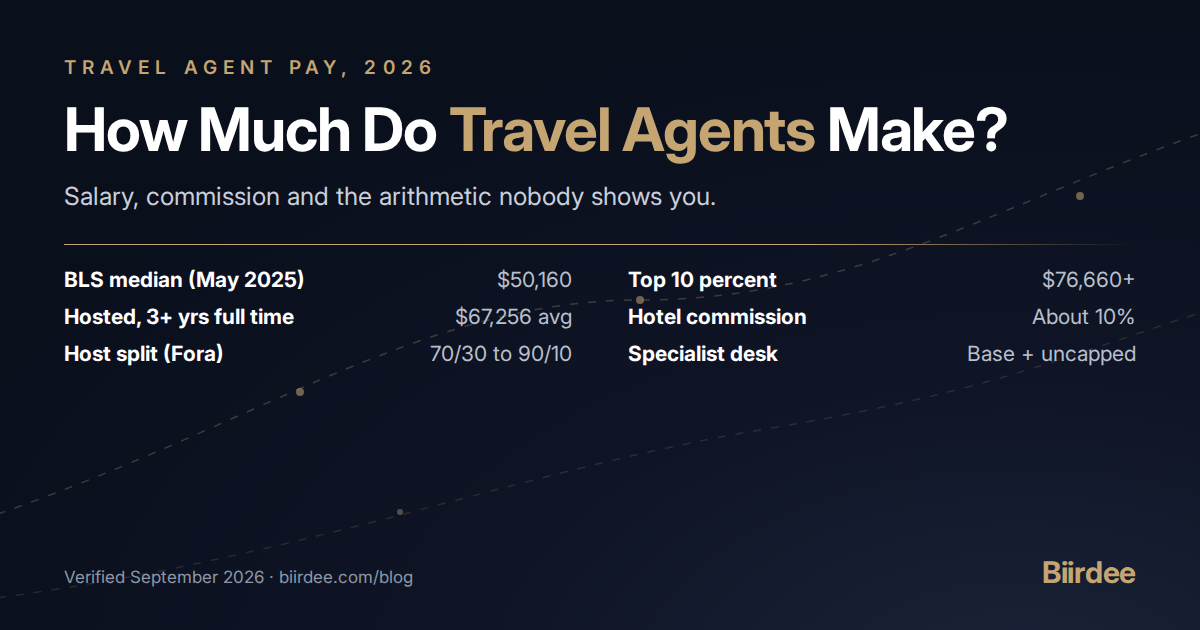
- $50,160 median annual wage. US Bureau of Labor Statistics, Occupational Employment and Wage Statistics, May 2025. The bottom ten percent earned under $34,610 and the top ten percent above $76,660. This survey counts employees, so it under-represents independents.
- $48,450 median annual wage. The BLS Occupational Outlook Handbook figure for May 2024, a year older than the one above. The Handbook also projects employment growth of about 2.2 percent from 2024 to 2034, with roughly 7,100 openings a year, mostly replacements.
- $67,256 average income for experienced full-time hosted advisors. Host Agency Reviews' 2024 survey, for full-time advisors with three or more years of experience. The same research found full-timers earned more than double what part-timers did. This is the closest thing to a published benchmark for the independent route.
- Not published: the specialist desks. Agencies that earn on the fare spread of premium cabins do not publish pay bands, and neither do we. What we can publish is the structure: a base salary plus uncapped commission. More on why "uncapped" means something different at a contracted desk below.
The gap between the $50,160 median and the $67,256 hosted average is not a contradiction. One counts everyone with the job title; the other counts people who survived three years and work full time. Survivorship is most of the story in this trade.
Why the Median Hides the Story
Three things sit inside that median. First, part-timers, who are a large share of hosted advisors and pull the average down. Second, first-year independents, whose income is often close to zero because commission is paid after the client travels and trips are booked months ahead. Third, the shape of the work: an agent booking $200 hotel nights at ten percent commission and an agent booking $6,000 business class tickets on a contracted fare can work the same hours and earn very different amounts.
So the useful question is not "what do travel agents make" but "what does each model pay per hour of skilled work, and how long until it pays at all." The three models are described in should I become a travel agent; here is the money side of each.
Model One: The Hosted Independent Advisor
You run your own business under a host agency, as an independent contractor. Income is a share of supplier commission plus any fees you charge. As of September 2026, the parts are these.
- Supplier commission. Hotels, cruise lines and tour operators pay the agency a percentage of the booking; ten percent is a common base for hotels and tours, with cruise lines and some hotel programs paying more, and airlines paying little or nothing on published fares. The client pays the same rate either way. That is why this model is hotel- and cruise-heavy and why airfare is a service rather than a revenue line for most independents.
- The split with the host. The host keeps a share. Fora, the most visible host in 2026, starts advisors at 70 percent of commission, moves to 80 percent at $300,000 in annual sales and 90 percent at $2 million, on a $299-a-year subscription (or $99 a quarter) that includes training, its platform and errors-and-omissions cover. Other hosts publish different splits and fees.
- Planning fees. Many advisors charge a fee per trip or itinerary, commonly a few hundred dollars, sometimes credited against a booking. Fees are the one part of the income you control directly, and the part new advisors are most reluctant to charge.
- Timing. Commission is collected from the supplier after the trip ends, and paid out on the host's cycle. Fora describes 30 to 90 days after travel, paid on a rolling two-week schedule. Add the months between booking and travel, and the first commission on a January booking often arrives in the second half of the year.
Worked example, illustrative only. An advisor who books $500,000 of hotels and cruises in a year at an average ten percent commission generates $50,000 in gross commission. At a 70/30 split that is $35,000; at 80/20 (which Fora reaches at $300,000 in sales) it is $40,000, before subscription, tools, marketing, self-employment tax and health insurance. To reach the $67,256 that experienced full-timers average, the same advisor needs roughly $800,000 to $1 million in annual sales, or a fee practice on top. That is a real business, built over years, which is why the three-year figure and the first-year figure are so far apart.
Model Two: The Employee at a Specialist Desk
You are hired by an agency that holds the contracts and the clients. This is Biirdee's model, so the details are ours.
- Base salary plus uncapped commission. Paid from month one, with no subscription and no client-finding. Commission is earned on the bookings you make; "uncapped" means there is no ceiling on it, not that there is no floor.
- What the commission is built on. On flights the agency earns inside the fare spread: the consolidator contract gives it a net rate, and the margin sits inside the discounted price the client pays, which is why clients pay no booking fee. The spread on one long-haul business class ticket is a multiple of the commission on a hotel night, so each hour of pricing work is worth more per booking than in the hosted model. On hotels and ground, the property or operator pays commission out of the rate the client would pay anyway.
- Clients provided. Requests arrive through the quote form, WhatsApp and referrals. Biirdee has served more than 16,000 luxury travelers as of September 2026, and the desk's job is pricing and servicing, not prospecting. This is the single biggest difference in the first-year experience.
- The trade-off. You do not own the book of business, you work the agency's hours and rota, and you sell what the agency sells: international premium cabins, private charter, luxury hotels and ground, not honeymoon packages. The pace is fast. The pay-from-day-one is the compensation for that.
We do not publish our base salary in a blog post because it varies by role and experience and we would rather discuss a real number in an interview than a range on a page. The careers page lists the three open roles: Flight Coordinator, Jet Charter Sales and Hotels Specialist.
Model Three: The Corporate TMC Agent
Travel management companies, and the booking platforms that front them, employ agents to handle bookings and changes for corporate travelers.
- Hourly or salaried, often with shift differentials. The pay is steady and sits near the BLS median. Evening, weekend and overnight shifts pay more at many employers.
- Transaction work. The client's company typically pays the TMC a fee per booking or per change (industry benchmarks put agent-assisted transactions around $25 as of 2025 and 2026), and the agent's output is measured in handled transactions. It teaches reservation systems and fare rules thoroughly.
- Little upside, little risk. There is no commission on most corporate work and no book to build. It is the most predictable of the three models and the least entrepreneurial, and for many people that is exactly right.
What Moves the Number
Across all three models, the same levers decide whether you land near $35,000 or above $75,000.
- Average booking value. Ten percent of a $12,000 cruise is $1,200; ten percent of a $180 hotel night is $18. The same conversation, the same paperwork, sixty times the commission. Luxury and premium-cabin niches pay more per hour because the tickets are bigger.
- Whether the desk holds contracts. Consolidator fares turn airfare from a courtesy into a revenue line. Independents mostly cannot access them; specialist desks are built on them. The anatomy of what a contracted desk holds is in how to become a luxury travel agent.
- Repeat rate. A client who books four trips a year is worth more than four new clients, and costs nothing to acquire. Service after the sale is what produces repeat clients, which is why the unglamorous half of the job is the profitable half.
- Fees you actually charge. The hosted advisors who earn well nearly all charge planning fees. The ones who earn badly nearly all give the planning away and hope the commission covers it.
- Hours. Host Agency Reviews found full-timers earning more than double part-timers. The trade rewards presence: the quote answered in the hour, the disruption handled at night.
The Costs the Brochures Skip
Independents should subtract these before comparing a hosted income with a salary.
- Subscription and tools. The host fee ($299 a year at Fora), a CRM or itinerary tool, a website, email marketing. Small individually; a few thousand a year together.
- Insurance and taxes. Errors-and-omissions cover is included by some hosts and not others. As a contractor you pay both halves of payroll tax and buy your own health insurance, which for a US household can be the largest single line.
- Unpaid planning. Every quote that does not book is hours you gave away. Specialist desks absorb this across a salaried team; an independent absorbs it personally.
- The runway. Six to twelve months before commissions flow, funded from savings. This is the cost that ends most hosted careers in year one, and it does not appear on any income survey because the people it affects have left.
The Honest Comparison
If you have a network of people who travel expensively, a niche you can name, comfort with selling, and a year of runway, the hosted route can outgrow a salary in years three to five, and you will own the business at the end of it. If you want to be paid from the first month, learn airfare pricing from people who hold contracts, and work with clients you did not have to find, a specialist desk pays better sooner and teaches faster, at the cost of ownership and autonomy. If you want predictability above everything, the corporate agent job is honest work at an honest wage.
None of these is the wrong answer. The wrong answer is choosing one because a page written by the party that profits from your choice told you it was easy. We have tried not to be that page, and we compare our model with the most popular host directly in should I work at Fora.
Frequently Asked Questions
- How much do travel agents make per year? The BLS median was $50,160 in May 2025, with the top ten percent above $76,660. Experienced full-time hosted advisors averaged $67,256 in Host Agency Reviews' 2024 survey. First-year independents typically earn far less because commission arrives after clients travel.
- How do travel agents get paid? Three ways. Supplier commission (hotels, cruises and tours pay a percentage of the booking, split with a host agency if there is one). The fare spread on contracted airfares (the agency earns inside a discounted fare, which is how specialist desks pay salaries). And fees charged to the client, per trip or as a membership.
- How much commission do travel agents make on a booking? Hotels and tours commonly pay around ten percent, cruise lines and some hotel programs more, airlines little or nothing on published fares. A hosted advisor then keeps 70 to 90 percent of that depending on the host and their sales volume.
- Do travel agents get a base salary? Employees at agencies and travel management companies do; independents do not. Biirdee pays its agents a base salary plus uncapped commission, with clients provided by the agency.
- Can you make six figures as a travel agent? Yes, in every model, and it is uncommon in every model. Independents who get there have a high-value niche, a fee practice and years of repeat clients. At specialist desks it comes from volume on large tickets. Anyone promising it in year one is selling something.
Sources: US Bureau of Labor Statistics, Occupational Employment and Wage Statistics (May 2025) and Occupational Outlook Handbook (May 2024 wage data); Host Agency Reviews, 2024 travel advisor income research; Fora's published pricing and commission terms. All checked in September 2026.
Biirdee · Careers
Paid From Month One, Uncapped After That
If the specialist model is the one you want, three roles are open. Send us a short note about your background; a real person reads every application and we will talk about real numbers in the interview.
The full role descriptions are on the careers page.
Questions?[email protected]
Keep reading