What It Is Actually Like to Be a Travel Agent: A Day at a Luxury Flight Desk
Not the Instagram version. One working day at Biirdee's flight desk, from the overnight queue to the on-call rota, with what the job rewards and what wears people down.
By Biirdee Team · September 16, 2026
There is a version of this job that exists on social media: a laptop by a pool, a hotel tour, a caption about "turning wanderlust into a career." Then there is the version that happens at a desk. This post is the second one, told hour by hour, at a specialist agency that books international business and first class, private charters, hotels and ground for clients across time zones.
Two caveats first. This is a day at our kind of desk. A hosted leisure advisor selling honeymoons has a different day, heavier on prospecting and itinerary design and lighter on airfare; the three versions of the trade are described in should I become a travel agent. And the day below is a composite, assembled from real ones, with the clients anonymized. Times are Pacific because Biirdee is based in Burlingame, California, and the desk answers clients worldwide.
6:40 a.m. The Overnight Queue
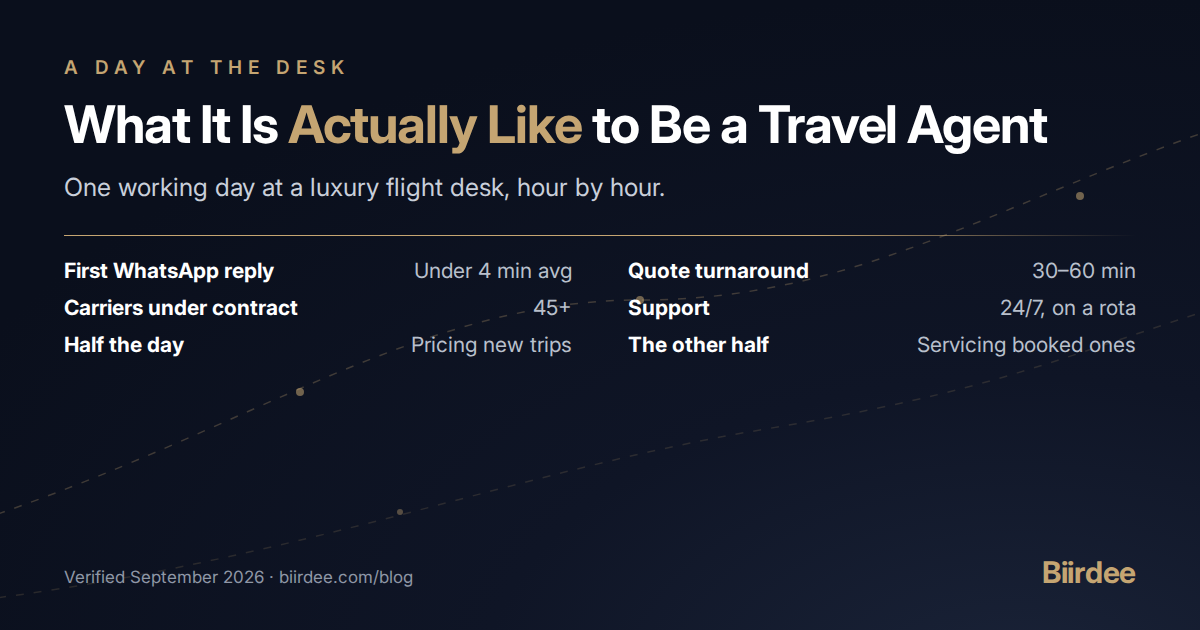
The day starts before the coffee, on the phone, in WhatsApp. Clients in Singapore, Dubai and London have been writing for hours. Some are new requests. Some are follow-ups: "did the seat change go through," "can you add my wife's frequent flyer number," "the hotel says they have no record of the breakfast." Each gets a first reply now, even if the full answer comes later; the desk averages under four minutes to a first reply during business hours, and the overnight backlog is where that number is won or lost.
Then the schedule-change queue. Airlines move flight times constantly, and every change to a ticketed itinerary needs a human decision: accept it, reissue it, or fight for a better option because the new connection is now 40 minutes. Three or four of these wait most mornings. Somewhere in the queue is a note from whoever was on call: a client's 11:40 p.m. departure cancelled at the gate, they were reprotected onto a partner airline by 12:30, and the hotel was told about the late arrival. That note is the product. Nobody outside the desk will ever see it.
8:00 a.m. Pricing a Quote
A brief lands: two adults, San Francisco to Singapore, business class, out on a fixed date in November, back within ten days, aisle seats, no red-eye on the outbound if avoidable. Budget stated, which helps. The target is a reply inside 30 to 60 minutes. Here is what happens in that hour.
- The contracts. Check the consolidator fares the agency holds with each carrier that flies or connects the route. These are the fares that never appear on Google Flights, loaded against the agency's own accounts in the reservation system. They are usually the floor. How they work is explained in unpublished business class fares.
- The published market. Check the airlines' own sales and the flexible published fares, because sometimes the public price wins on a given date, and the client is told so.
- The constructions. Price it as two one-ways. Price it with a different carrier each direction. Price economy on a short feeder leg with business on the long overnight. Price the return from a nearby airport. Half the savings on premium cabins live in construction, not in any single fare.
- The points path. If the client holds transferable points, check whether an award seat exists on the dates and whether it beats the contracted fare. Some days it does. The client is told which is better and why.
- The reply. Two or three options, each with the airline, routing, cabin, fare rules, mileage earning and the all-in price in writing. Not twenty lines. If the reply is a list of search results, the client has been handed a search, not advice.
The craft is in that comparison across channels, and it is what a new agent learns first. It is also why the job rewards people who find fare logic interesting rather than merely useful.
10:30 a.m. Ticketing, and the Boring Parts That Matter
A client from yesterday approves an option. Now the unglamorous half begins. Names are checked against passports, letter by letter, because a mismatch is a reissue. Payment is taken (card, bank transfer, Zelle or crypto; the desk recommends bank transfer above $10,000 to avoid card fees). The ticket is issued and the 13-digit e-ticket number goes to the client with the record locator, and the agent checks that the booking loads on the airline's own website before sending it. That last check takes 30 seconds and prevents the worst category of problem.
Then the file is dressed: seats assigned from the seat map, frequent flyer numbers added, meal codes set, a lounge question answered, a note about the client's arrival transfer. None of it is difficult. All of it must be done, every time, and it is the part of the job that people who imagined only the search half find hardest to sustain.
Midday: The Servicing Half
From late morning the queue is mostly servicing: work on trips already booked. A representative hour, as of September 2026, looks like this.
- A refund chase. An airline cancelled a flight three weeks ago. The refund is owed and has not arrived. Airlines take weeks; the agent follows up, documents it, and tells the client the honest timeline.
- A wheelchair request and a greeter. An older client is flying through Doha. The agent adds assistance to the booking and arranges a meet-and-greet through the connection. The airport greeter is a real person the desk has booked before.
- A hotel partner request. A client at a preferred-partner property wants a late checkout. The agent writes to the hotel contact. Preferred-partner perks are priority, not promises, and the reply says so honestly.
- A "which program should I transfer to" question. Five minutes of advice that earns nothing today and keeps a client for years.
- A jet charter quote in progress. The charter side is a separate craft: aircraft category, operator safety ratings, positioning costs, a deposit to hold the aircraft. Charter quotes typically take two to four hours and are handled by the people who do that all day.
2:00 p.m. A Change Request
A client wants to move a return by two days. On a contracted fare the answer depends on the fare rules stated in the original quote: typically a change fee plus any fare difference, processed by the agency rather than the airline's app. The agent reprices the new date, states the total in writing, and lets the client decide. Nothing is changed until they say yes.
This is the moment the earlier honesty pays off. Because the trade-offs were in the quote before payment (change terms, refund terms, mileage earning), the conversation is short. When an agent hides those terms to win the sale, this is the conversation that becomes a complaint. The rule at a good desk is simple: the client never learns a fare rule for the first time when they need it.
4:00 p.m. The Honest No
A request comes in for a domestic economy round trip next month. The desk cannot beat the published fare on that; the contracts cover long-haul premium cabins, and availability for US domestic and economy tickets is limited to none. The agent says so, points the client to book direct, and offers to help with the international leg later in the year. It earns nothing today. It is the reply that makes the next quote credible, and every agent here is expected to send it without hesitation.
The same afternoon usually includes at least one case where the published fare genuinely wins on a route and date, and the client gets that answer too. Our page on how our pricing works says "sometimes we cannot, and we say that." At the desk, that is a sentence typed several times a week.
Evening and the On-Call Rota
The desk offers 24/7 support and flight monitoring on concierge bookings, which means someone is always on. On a rota night the phone is beside the bed. Most nights nothing happens. The nights something happens are the whole reason the service exists: a cancellation at the gate, a missed connection in Frankfurt, a client at a closed hotel desk at 1 a.m.
What a good agent does in the first twenty minutes of a disruption is the most skilled work in the job. Read the fare rules on the ticket. Know which partner airlines the client can be reprotected onto and which routing the airline will accept without a fare difference. Get the new seat confirmed while two hundred people are in one line. Tell the hotel. Text the client something calm and specific. Then write the note for the morning queue. If that paragraph reads as exciting rather than exhausting, you are the kind of person the desk wants.
What the Work Rewards
- Pattern memory. Which carrier opens partner award space close to departure. Which alliance prices one-ways badly. Which client will not take a middle seat under any circumstances. The library in your head is the asset.
- Writing. The job is mostly written now. A quote a client understands in one read, a disruption message that lowers someone's heart rate, an email that gets a supplier to act. Clear writers do well here.
- Negotiation with suppliers. Rates, waivers, exceptions, a room category the hotel says it does not have. Persistent politeness moves things.
- Product curiosity. New cabins, new routes, changed award charts, a carrier's new Wi-Fi. The agents who read this for fun are the ones clients ask for by name.
What Wears People Down
- The global clock. Clients on three continents means early mornings, some evenings and an on-call rota. It is manageable and it is real.
- Error costs. A wrong middle name on an issued ticket is a reissue with a real cost. The job asks for a level of care most office work does not, every day, without variance.
- The pace. Quotes are expected within the hour. Inventory moves while you type. Contracted seats have a shelf life measured in hours, and clients are told which options are fragile.
- The emotional labor of disruption. You absorb someone's worst travel day and hand back a plan. It is satisfying and it is tiring, and people who cannot switch off afterwards struggle.
The Tools, and Whether You Need to Know Them Already
A global distribution system (Sabre, Amadeus or Travelport) for fares, availability and ticketing. Consolidator portals for the contracted inventory. Airline websites for verification and seat maps. Award search tools. A CRM for client files. WhatsApp and email for almost all client contact. The Flight Coordinator role lists GDS experience as a plus rather than a requirement, and that is accurate: the system is learnable in weeks, and the pricing judgment it serves takes a year. We hire for the judgment and teach the system.
You do not need to have worked in travel. Our team includes a former Porsche general manager and a DJ who became a concierge. You need to be the sort of person who, reading the day above, wants to be the one who wrote the 12:30 a.m. note.
Frequently Asked Questions
- What does a travel agent do all day? At a specialist desk: answer the overnight queue, price new requests across contracts, published fares, constructions and points, issue and verify tickets, service booked trips (seats, changes, refunds, requests) and handle disruptions on a rota. Roughly half the day is pricing new trips and half is servicing existing ones.
- Is being a travel agent stressful? In bursts. Quotes are expected within the hour, mistakes cost real money, and disruptions arrive without warning. Between bursts it is detailed, quiet work. People who like solving problems under a clock find it energizing; people who need a predictable day do not.
- Do travel agents work weekends and nights? At any desk that offers 24/7 support, someone does, on a rota. Most nights are quiet. The rota is the price of the service, and applicants should ask about it at any agency they consider.
- Do you need a GDS to be a travel agent? Most agencies that issue airline tickets use one (Sabre, Amadeus or Travelport), and knowing one helps. It is not required at Biirdee for the coordinator role; it is taught.
- How is a leisure advisor's day different? A hosted leisure advisor spends far more time finding clients and designing itineraries, and far less on airfare mechanics, because most host-agency income is hotel, cruise and tour commission paid after the client travels. The comparison is in should I work at Fora.
Response times and role details in this post are current as of September 2026 and will change.
Biirdee · Careers
If This Day Sounds Like Yours
We hire for temperament and teach the systems. Tell us what you have done and why the desk appeals; the form takes two minutes and a real person reads it.
The full role descriptions are on the careers page.
Questions?[email protected]
Keep reading
Related Posts
September 16, 2026
Should I Become a Travel Agent? An Honest Answer From a Desk That Hires Them (2026)
September 16, 2026
How Much Do Travel Agents Make? Salary, Commission and the Arithmetic Nobody Shows You (2026)
September 16, 2026
Should I Work at Fora? A Fair Look at the Host-Agency Model Against a Salaried Desk