Should I Work at Fora? A Fair Look at the Host-Agency Model Against a Salaried Desk
Fora is the most visible door into the trade in 2026. Most write-ups are by Fora or by advisors who earn from referring you. We are neither; we are a competing kind of employer, and we have tried to be fair.
By Biirdee Team · September 16, 2026
Search this question and the results are mostly two things: Fora's own pages, which are well made and exist to enrol you, and posts by Fora advisors, many of whom earn a referral benefit when you sign up under them. Neither is dishonest. Both have a reason to say yes. This post has a different one. Biirdee is a specialist travel agency that hires agents on a salary, which makes us a competing kind of employer, not a neutral party. Read it that way, and check the terms yourself before acting on them.
What follows is what Fora is, what it does well, what to work out before you pay the subscription, and a side-by-side with the salaried model. Every Fora figure is taken from its published pages as of September 2026 and will change; the comparison logic will not.
What Fora Is
Fora is a host agency: a company that provides independent travel advisors with the accreditation, supplier relationships, booking tools and training they need to sell travel, in exchange for a subscription and a share of commission. The facts, as of September 2026:
- Founded in 2021 in New York by Henley Vazquez, Evan Frank and Jake Peters. It reports more than 15,000 active advisors and more than $3 billion in lifetime bookings, and in July 2026 it raised a $60 million Series D at a $1 billion valuation. It is a real, well-funded company.
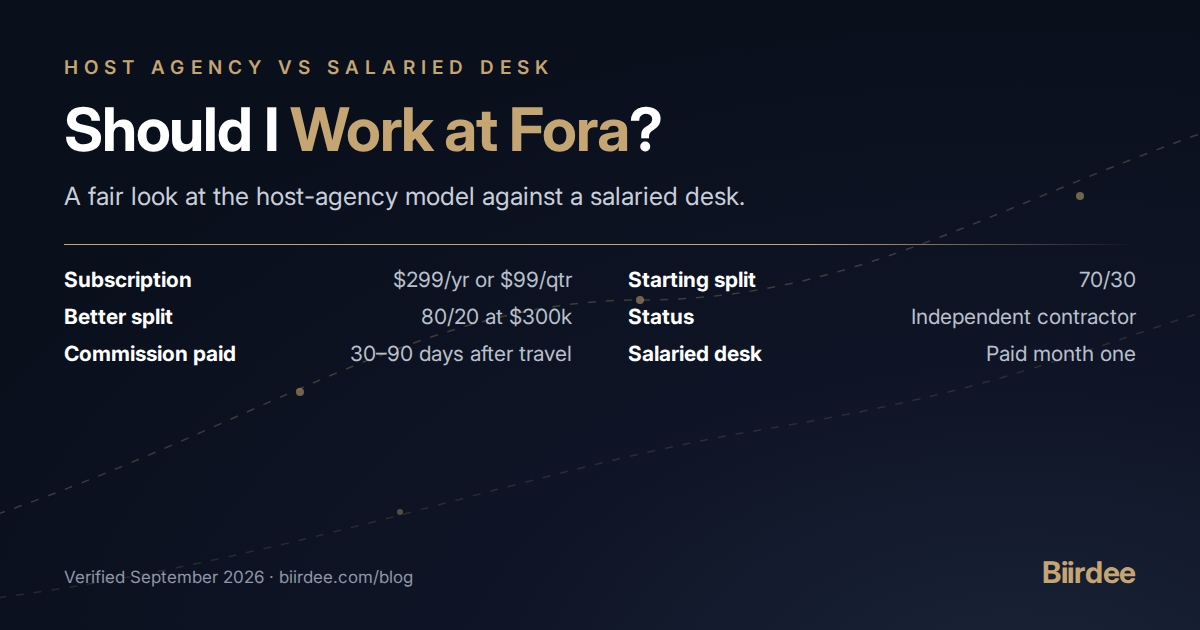
- The subscription is $299 a year, or $99 a quarter. It includes training, the booking platform, errors-and-omissions cover and access to Fora's supplier programs. There are no booking minimums.
- The commission split starts at 70/30. Seventy percent to the advisor, thirty to Fora, moving to 80/20 at $300,000 in annual sales and 90/10 at $2 million.
- Advisors are independent contractors. Not employees. No salary, no benefits, self-employment tax, and you find your own clients. Fora pays commission after the client travels and the supplier pays out, which it describes as typically 30 to 90 days after the trip, on a rolling two-week schedule.
The first thing to understand follows from that list. You would not be "working at Fora." You would be starting a business that uses Fora as its back office. Fora's revenue is your subscription plus its share of what you sell. That is not a criticism; it is the model, and it explains everything else on this page.
What Fora Does Well
Credit where it is due, and there is a fair amount due.
- The barrier to entry is low. For $299 you get accreditation you could not get alone, supplier programs it took Fora years to assemble, insurance, and a platform. Historically, entering the trade independently meant far more cost and paperwork.
- The training and community are real. New advisors get a structured program and a large peer network. For someone learning the trade from zero, that is worth a great deal, and it is the part advisors praise most consistently.
- Hotel relationships that matter. Preferred-partner programs mean a Fora booking at a participating hotel carries perks (upgrade priority, breakfast, property credit) at the same rate as booking direct, and the hotel pays the commission. That is a genuine product to sell, and it is the core of the model.
- The split improves with volume. Seventy percent is not generous by host-agency standards, but 80 and 90 percent at the higher tiers are competitive, and the tiers are published.
- Flexibility. Part-time is possible. Many advisors run it alongside another job or around a family. No employer offers that.
Work These Out Before You Pay
None of these are secrets. They are the questions the enrolment pages answer least directly.
- Where will your first thirty clients come from? Fora provides the tools, not the customers. If you cannot name the people in your life who travel expensively and would book through you, the platform will be very quiet. Advisors who succeed nearly always start with a network.
- How long can you fund yourself? Commission arrives after the client travels, plus the payout cycle. A trip booked in January for August pays in the autumn. Twelve months of runway is a sensible planning assumption; some advisors need more. The arithmetic is in how much do travel agents make.
- Do the sales math with your real numbers. At a ten percent average commission and the starting 70/30 split, $300,000 of bookings in a year is $21,000 to you before expenses and tax. To clear a full-time income you are looking at several hundred thousand dollars of sales more than that, or a fee practice on top. Possible, and a multi-year build.
- Understand what you will actually sell. The host model earns on hotels, cruises and tours. Airfare pays little or nothing on published fares and is complex to service, so for most host-agency advisors flights are a courtesy rather than a revenue line. If the part of travel you love is aviation, that matters.
- Know who is reviewing whom. Many positive Fora write-ups are by advisors with a referral link. Many negative ones are by people who left in year one, which selects for the runway problem above. Weight both accordingly.
- Ask about exits and ownership. Your clients are yours in practice; check the terms on what happens to bookings in progress and to supplier relationships if you leave. Good hosts are clear about this. Ask before, not after.
Host Agency vs Salaried Desk, Line by Line
Biirdee hires agents as employees: a base salary plus uncapped commission, remote-first, with clients provided. Here is how the two models differ on the things that decide whether you are happy in year two.
- When you are paid. Host: after your client travels, months after the sale, and only once you have sold. Desk: from month one, on salary, with commission on top.
- Who finds the clients. Host: you. Desk: the agency. Biirdee's requests arrive by quote form, WhatsApp and referral from more than 16,000 clients served; the agent's job is pricing and servicing, not prospecting.
- What you sell. Host: whatever your clients want, weighted toward hotels, cruises and tours, where the commission is. Desk: what the agency specializes in. At Biirdee that is international business and first class on consolidator contracts with more than 45 carriers, private charter, luxury hotels and ground.
- What you learn. Host: itinerary design, hotel programs, marketing yourself. Desk: airfare pricing across contracts, published fares, constructions and points, ticketing and reissues, disruption handling at 2 a.m. The two skill sets barely overlap.
- Risk and upside. Host: you carry the risk and own the upside; a strong practice can out-earn a salary in years three to five and is yours to keep or sell. Desk: the agency carries the risk; your upside is commission on volume, not equity in a book.
- Hours. Host: your own, including the unpaid ones. Desk: the agency's, including a rota for 24/7 support. Ask any employer about the rota before you accept.
- Benefits and taxes. Host: you are a contractor; you buy your own health cover and pay self-employment tax. Desk: employment, with whatever the employer offers.
Who Should Choose Fora
Someone with a network of people who spend on travel, a niche they can describe in one sentence, comfort with selling to people they know, a year or more of runway, and a preference for owning something over being paid for something. Someone who wants flexible hours more than a predictable income. Someone whose interest is hotels, cruises and trip design more than aviation. For that person, Fora is a sensible, well-built way in, and we would say so to a friend.
Who Should Choose a Desk Like Ours
Someone who wants to be paid from the first month. Someone who finds fare logic interesting and wants to learn it from people who hold the contracts, which is not something a host can teach because most hosts do not hold them. Someone who would rather price and service trips than market themselves. Someone who wants a team and a rota rather than a solo practice. For that person, the Flight Coordinator role is the honest description of the job, and what it is like to be a travel agent is the honest description of the day.
Our downsides, stated: the pace is fast, the on-call rota is real, we are a specialist rather than a generalist, and you will not own the book. People who want a slow leisure practice built around their own taste in travel are happier at a host, and we tell them so.
Can You Do Both?
Not usefully, and usually not at all. Employers in this trade will expect that you are not selling travel independently on the side, for the obvious conflict-of-interest and confidentiality reasons, and a host practice needs the hours you would be giving an employer. Some people start at a desk to learn the craft and later go independent; others do the reverse when the runway runs out. Both are honorable. Sequential works. Simultaneous does not.
Frequently Asked Questions
- Is Fora legit? Yes. It is a real host agency, founded in 2021, with more than 15,000 advisors, more than $3 billion in lifetime bookings and a $1 billion valuation as of July 2026. Legitimate is not the same as right for you; the questions above are the ones that decide that.
- Is Fora a pyramid scheme or an MLM? No. Its revenue comes from advisor subscriptions and its share of supplier commissions on real travel bookings. You do not need to recruit anyone to earn. Some advisors promote referral links, which is why so many reviews are written by advisors, but recruiting is not the business model.
- How much does it cost to join Fora? As of September 2026, $299 a year or $99 a quarter, which includes training, the platform, errors-and-omissions cover and supplier programs. The larger cost is the unpaid months before commission flows.
- How much do Fora advisors make? Fora does not publish a median, and neither does any host. The closest public benchmark is Host Agency Reviews' 2024 finding that experienced full-time hosted advisors averaged $67,256, with part-timers earning less than half that and first-year advisors far less. Your number depends on your network, your niche and whether you charge fees.
- Is Fora better than a salaried travel agent job? It is different, not better or worse. Fora offers ownership, flexibility and a low entry cost, paid for with risk, runway and prospecting. A salaried desk offers pay from month one, provided clients and a specialist craft, paid for with less autonomy and no ownership. Decide which trade you want.
Fora's terms in this post are quoted from its published pages as of September 2026 and will change; confirm the current subscription price and split before you sign up.
Biirdee · Careers
The Other Door
If you would rather be paid from month one and learn the airfare craft from people who hold the contracts, three roles are open. Tell us about yourself; a real person reads every application.
The full role descriptions are on the careers page.
Questions?[email protected]
Keep reading
Related Posts
September 16, 2026
How Much Do Travel Agents Make? Salary, Commission and the Arithmetic Nobody Shows You (2026)
September 16, 2026
Should I Become a Travel Agent? An Honest Answer From a Desk That Hires Them (2026)
September 16, 2026
What It Is Actually Like to Be a Travel Agent: A Day at a Luxury Flight Desk