Should I Become a Travel Agent? An Honest Answer From a Desk That Hires Them (2026)
Most answers to this question come from a host agency that earns from your subscription or from someone who thinks the internet ended the job. Here is the view from a desk that pays salaries, and only benefits if you are good at it and stay.
By Biirdee Team · September 16, 2026
If you type this question into a search engine you get two kinds of answer. The first comes from host agencies and the advisors affiliated with them, and it is warm: yes, anyone can do it, start this week. The host earns a subscription fee and a share of your commissions, so it has a reason to say so. The second comes from people who last used a travel agent in 2004, and it is dismissive: the internet ate that job. Both are wrong in ways that cost people money and years.
We run a travel desk. Biirdee books international business and first class, private jet charters, luxury hotels and ground for clients worldwide, and we hire agents on a salary. That gives us a different incentive from either camp: we only gain if the person we hire is good at the work and stays. So this post is the answer we would give a friend. It covers what the job actually is in 2026, who thrives, who quits, what it pays, and the three doors into the trade, with a short self-test at the end. Figures are current as of September 2026 and will move.
The Short Answer
Become a travel agent if most of these are true of you.
- You like solving other people's logistics more than you like traveling. The job is booking trips, not taking them. Familiarization trips exist and are rare. The hours are spent at a desk, on a phone, in a reservation system.
- You are calm when a plan breaks. The product is what happens when a flight cancels at 11 p.m. and 200 people are in one line. If that scenario makes you focus rather than panic, you have the temperament.
- You can hold a hundred small details without dropping one. A passport name spelled wrong is a reissued ticket. A missed fare rule is a client paying a change fee you did not warn them about. Detail is the job, not a nice-to-have.
- You are comfortable with money conversations. Every version of the job involves asking someone what they will spend and telling them what something costs. People who soften that step earn less.
- You want to learn a craft that keeps changing. Airline products, fare rules, award charts and hotel programs change monthly. The people who thrive find that interesting rather than tiring.
Do not become one if you want to travel for a living, want an income that arrives without selling, hate the phone, or need every day to look like the last. Those are not character flaws. They are a mismatch, and it is cheaper to know now.
Three Jobs Share One Title
"Travel agent" describes three different jobs with different pay, hours and entry points. Most bad advice comes from someone describing one of them as if it were all three.
- The hosted independent advisor. You run your own business under a host agency (Fora is the most visible example in 2026), pay a subscription, find your own clients, and earn a share of supplier commissions, mostly on hotels, cruises and tours. You are an independent contractor. The upside is ownership and flexibility; the cost is that nothing pays you until you have sold, and commission arrives after your client travels. We compare this model with ours in should I work at Fora?.
- The agent at a specialist desk. You are an employee. The agency holds the airline contracts, the hotel partnerships and the client base; you price, book and service trips, on a base salary plus commission. This is what Biirdee's Flight Coordinator role is. You learn the pricing craft from people who hold consolidator contracts, and you are paid from month one. The trade is less autonomy and a faster pace.
- The corporate travel management agent. You work shifts for a travel management company, handling bookings and changes for corporate travelers who reach you through a portal or a phone line. It is structured, reservation-system heavy and steady. It teaches the mechanics well and the sales side barely at all.
Decide which of the three you mean before you decide whether to do it. The answer can be yes for one and no for the others.
The Job Did Not Die, It Moved
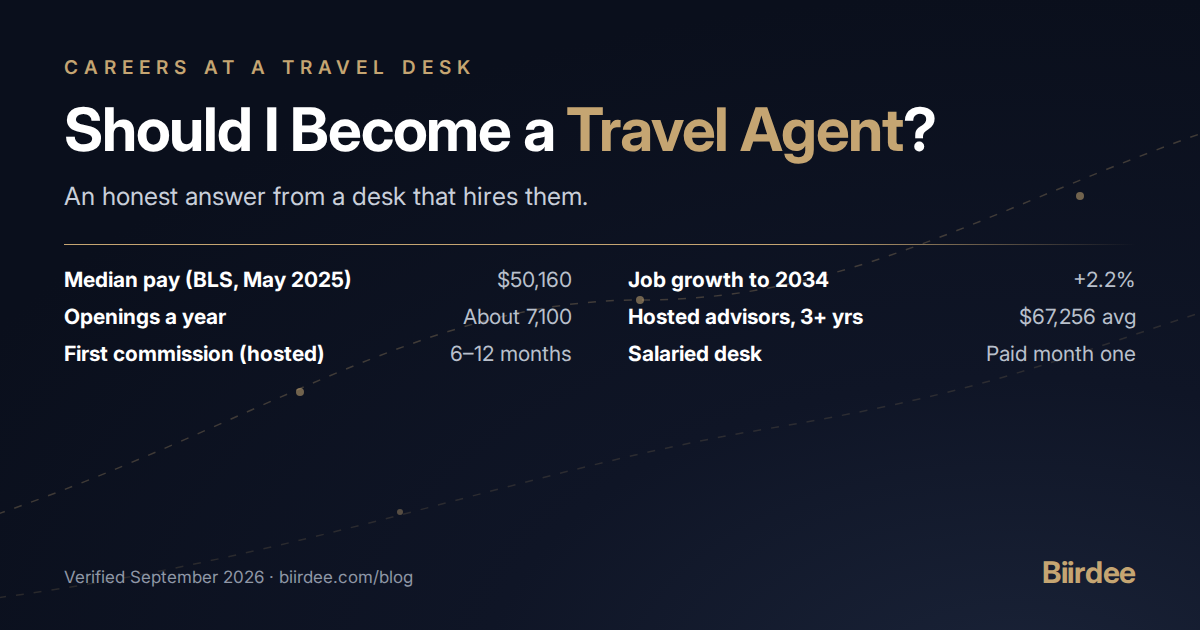
The US Bureau of Labor Statistics projects travel agent employment to grow about 2.2 percent from 2024 to 2034, with roughly 7,100 openings a year, most of them replacing people who leave. That is not a boom. It is also not the collapse that people who booked their last flight on an airline app assume. Business travel spending is forecast by the Global Business Travel Association to reach a record $1.71 trillion in 2026, and the trips that money buys are getting more expensive and more selective, which is exactly the kind of travel people pay a human to handle.
What survived the internet was the part of the job a search engine cannot do. Airlines still distribute discounted business and first class through private consolidator contracts that never appear on Google Flights, and only accredited agencies can sell them. Complex trips (multi-city, open-jaw, mixed carriers, award seats) still need a person who can price one itinerary six ways. And when a plan breaks, the traveler with a desk holding their file gets rebooked while everyone else is on hold. The economics are laid out in why travel agents still exist; the short version is that the job moved up-market and into the hard cases, and that is where the pay is.
What It Pays, in One Paragraph
The BLS put the median annual wage for travel agents at $50,160 in its May 2025 estimates, with the bottom ten percent under $34,610 and the top ten percent above $76,660. Host Agency Reviews' 2024 survey found full-time hosted advisors with three or more years of experience averaged $67,256, and that full-timers earned more than double what part-timers did. Those numbers hide two things. First, the independent route starts near zero: commission is paid after the client travels, so a business started in January is often not paying its owner until the following year. Second, the specialist end of the trade pays differently, because the margin on one discounted business class ticket is a multiple of the commission on a hotel night. We go through every model, with the arithmetic, in how much do travel agents make.
Who Thrives
Our own team came to the desk from running a Porsche dealership, from DJing and concierge work, from acting, from crypto markets and from long airline careers. None of that predicts success. These things do.
- Pattern memory. You remember that a particular carrier releases partner award space at a particular time, that one alliance prices one-ways badly, that a client hates the aisle. The good agents carry a working library in their heads and add to it daily.
- Written clarity. Most of the modern job is written: WhatsApp threads, quotes with fare rules, emails to suppliers. An option a client can understand in one read is worth more than a lower fare they cannot.
- The honest no. The agents clients trust are the ones who say "book this one direct, we cannot beat it." That costs a sale and buys the next ten. If saying it makes you uncomfortable, the job will.
- Stamina for the unglamorous half. Ticketing, reissues, refund chases, seat maps, meal codes and frequent flyer numbers are the second half of every booking. People who only want the first half (the search) burn out inside a year.
- Comfort with a global clock. Clients in Asia and Europe write while you sleep. Someone on the desk answers. If a rota that includes early mornings and some evenings is a deal-breaker, say so before you apply anywhere.
Who Quits, and Why
The same handful of reasons come up every time. None is about ability.
- They wanted to travel. The job is adjacent to travel the way an accountant is adjacent to money. There are perks, and there are occasional supplier trips. There is no version of the job where the job is being on holiday.
- They ran out of runway. Independents who did not budget for a year of thin income leave in the first year. This is the single biggest reason hosted advisors stop, and it is a cash-flow problem rather than a talent problem.
- They could not tolerate error costs. Mistakes are expensive and public. A wrong date on an issued ticket is a real cost to a real person. Some people find that motivating; others find it unbearable.
- They did not like selling. Even at a salaried desk, you close. You present two options and ask for a decision. People who wanted a pure service role and got a sales role leave.
The Three Doors, and What Each Costs to Open
As of September 2026, this is what entry looks like.
- A host agency. Fora charges $299 a year, or $99 a quarter, and includes training, its booking platform, errors-and-omissions cover and supplier programs. You keep 70 percent of commission to start, rising to 80 percent at $300,000 in annual sales. The real cost is not the fee. It is the twelve to twenty-four months of building a client list before the income is meaningful, funded by you.
- A specialist desk. Apply. At Biirdee the Flight Coordinator role asks for communication, attention to detail, pace and a real interest in aviation and luxury travel; GDS experience is listed as a plus, not a requirement, because the craft is taught at the desk. Compensation is a base salary plus uncapped commission, the culture is remote-first, and clients come from the agency rather than your address book.
- A travel management company. The large TMCs and the portal companies that front them hire agents in shifts, often with a training program. Expect reservation-system work, corporate policy rules and a steady wage. It is the most predictable door and the least entrepreneurial.
A fourth door is a certificate course. Be careful with it. No certificate is required to work at most desks, and none teaches the pricing craft; the anatomy of what an elite desk actually holds is in how to become a luxury travel agent. Spend the money on runway or on a GDS course instead.
A Six-Question Self-Test
Answer honestly. Four or more yeses and the job is worth a serious look.
- When a friend's flight is cancelled, do you enjoy being the person who finds the workaround?
- Can you tell someone a price, wait for the answer, and not fill the silence?
- Do you read the fare rules, the terms, the fine print, and notice when something is off?
- Are you fine with a working day that is mostly writing and reading rather than talking?
- Could you fund yourself for a year with little income, or would you rather be paid from month one? (Either answer is fine. It tells you which door.)
- Do you find airline product news, award charts and hotel programs genuinely interesting, or only useful?
If most of your yeses came with "as long as I am paid from the start and someone else finds the clients," you are describing a salaried desk. If they came with "as long as I own it," you are describing the hosted route. What a day at our kind of desk actually contains is in what it is like to be a travel agent.
What We Look For
We are a specialist. Biirdee negotiates fares with more than 45 major carriers, books premium cabins through unpublished fares that never reach the public booking sites, and answers the average WhatsApp message in under four minutes during business hours. That shapes who does well here. We hire people who can write clearly, who like the pricing puzzle, who are unflustered by a schedule change at 6 a.m., and who would rather tell a client the truth than make the sale. Three roles are open as of September 2026: Flight Coordinator, Jet Charter Sales and Hotels Specialist. The descriptions on the careers page are honest about what each day contains.
We will also say plainly what we are not. We do not sell honeymoon packages or all-inclusives, we book almost no US domestic economy, and the pace is fast. If the version of the job you want is a slow leisure practice built around your own travel taste, the hosted route fits better, and we would rather tell you that than hire you for the wrong reasons.
Frequently Asked Questions
- Is being a travel agent still a good career in 2026? For the specialist and corporate ends of the trade, yes: the work airlines and search engines cannot do (private fares, complex itineraries, disruption handling) is where demand and pay concentrate. Employment is projected to grow modestly, about 2.2 percent through 2034 according to the BLS, so it is a stable trade rather than a growing one.
- Do I need a license or certification? The heavyweight credentials sit with the agency, not the individual: ARC or IATA accreditation to issue tickets and state paperwork such as California's Seller of Travel registration (Biirdee Inc. holds CST 2138352). Most desks require no personal certificate. Some states require sellers of travel to register; check yours if you go independent.
- How long before I earn money? At a salaried desk, from your first month. As a hosted independent, usually six to twelve months before commissions flow, because suppliers pay after the client travels and trips are booked months ahead. Budget for a lean first year if you take that route.
- Do travel agents get to travel? Less than people expect. There are industry rates, occasional supplier familiarization trips and, at some desks, travel perks. The job itself happens at a desk. If free travel is the goal, this is an expensive way to get it.
- What background do you hire from? There is no standard résumé. Our team includes a former Porsche general manager, a DJ turned concierge and an actor alongside people with long airline careers. What we look for is temperament: written clarity, attention to detail, calm under pressure and genuine curiosity about the product.
Pay figures and program terms in this post were checked in September 2026 and will change. Verify the current numbers before you make a decision on them.
Biirdee · Careers
See What the Desk Is Hiring For
Three roles are open. If the self-test came out yes, tell us about yourself. The form takes two minutes and a real person reads every application.
The full role descriptions are on the careers page.
Questions?[email protected]
Keep reading
Related Posts
September 16, 2026
What It Is Actually Like to Be a Travel Agent: A Day at a Luxury Flight Desk
September 16, 2026
How Much Do Travel Agents Make? Salary, Commission and the Arithmetic Nobody Shows You (2026)
September 16, 2026
Should I Work at Fora? A Fair Look at the Host-Agency Model Against a Salaried Desk