Planned a Trip With AI? Nine Things to Check Before You Pay
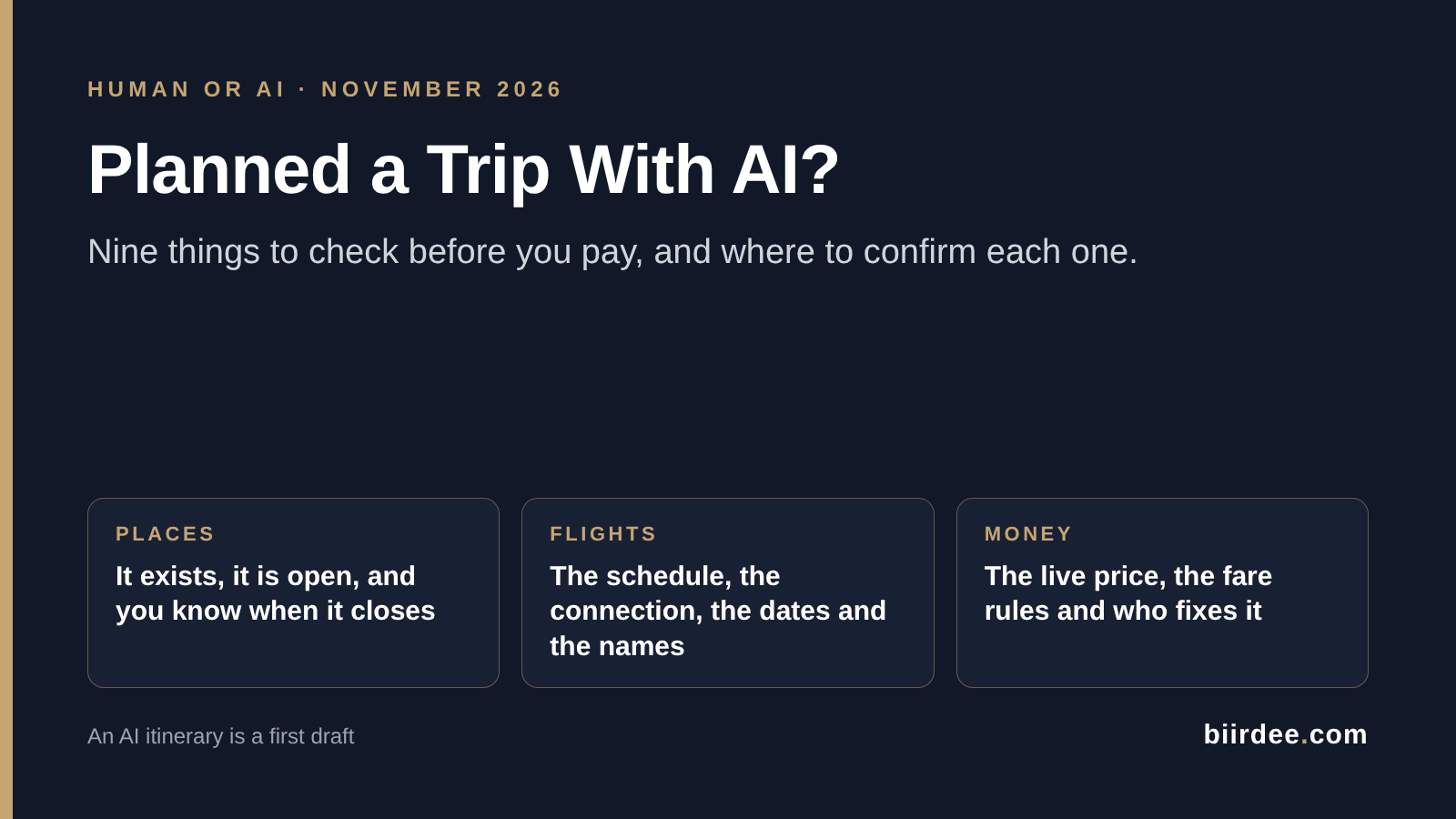
An AI itinerary reads like a finished plan and should be treated as a first draft. These are the nine checks a careful agent runs on any trip, where to confirm each one, and what to do if you would sooner hand the whole thing to a person.
By Biirdee Travel, Luxury Travel Concierge · Updated November 23, 2026
The Short Answer
Treat an AI trip plan as a draft written by a well-read stranger who has never been there. Before you pay for anything, check nine things: that every place exists, that it is open on your dates, the hours and last departures, that the flights operate as described, that the connections can be made, that the dates and names line up, the passport and entry rules, the real price and its fare rules, and who you call when something breaks.
The reason is simple. An AI model writes what is plausible, and it writes the wrong details in the same assured voice as the right ones. In a survey Greetwell commissioned in August 2026, 1,000 US leisure travelers were asked, and 485 had used AI for travel. Of those, 55% had been given at least one bad recommendation and 16% had been recommended a place, tour or activity that did not exist.
The checks take an hour or two for a week's trip. The alternative is to send the plan to a human agent, who runs them as a matter of course and prices the trip while doing it. Either way, do not skip them.
Key Takeaways
- An AI itinerary is a first draft. It is good for ideas and structure, and unreliable on the details that decide whether a day works.
- The most common fault is small and specific: 27% of AI-using travelers in the Greetwell survey were given incorrect prices, hours or other details.
- Confirm each fact at its source: the venue's own site, the airline's schedule, the government's entry page. Do not ask the AI to confirm its own answer.
- Connections and dates are where plans quietly break: a transfer between two airports, an overnight flight that lands a day later, a hotel booked for the wrong night.
- The price an AI quotes is a guide at best. Check the live, all-in price and the change and refund rules before you pay.
- A careful human agent runs these checks as a matter of course. Sending us the plan costs nothing, and on long-haul business and first class the price usually comes back lower.
The Nine Checks at a Glance
Work down the list for every day of the plan. The third column is where the true answer lives, and it is never the AI that wrote the plan.
| Check | What goes wrong | Where to confirm it |
|---|---|---|
| 1. The place exists | An invented sight, tour or restaurant, or a real name in the wrong town | A map, and the place's own website |
| 2. It is open on your dates | Closed for the season, for renovation, or every Monday | The venue's or hotel's own site, or a phone call |
| 3. Hours and last departures | The last cable car, ferry or train leaves earlier than stated | The operator's current timetable |
| 4. The flight operates as described | A route that does not run that day, or a schedule from another season | The airline's own site, for your exact date |
| 5. The connection can be made | Too little time, a change of airport, or two separate tickets | The airline, and the airport's transfer guidance |
| 6. Dates and names line up | An overnight flight lands a day later; a name does not match the passport | The itinerary beside the passport and a calendar |
| 7. Passport and entry rules | Validity, visas and transit rules that are out of date or wrong for your nationality | The destination government's official page |
| 8. The real price and fare rules | A stale or partial price; a fare that cannot be changed | The live quote, with taxes, fees and rules in writing |
| 9. Who fixes it | No one to call when a flight cancels at midnight | The seller's terms and contact details, before you pay |
Checks 1 to 3: Is It Real, Is It Open, and When Does It Close?
Start with whether the place exists. That sounds absurd until you read the reports. The BBC described two travelers in Peru heading into the mountains for a "Sacred Canyon of Humantay" that an AI tool had described and that is not on any map; a local guide stopped them. We read the story in Futurism's account of 4 October 2025. Search each sight, restaurant and tour by name, find it on a map, and find its own website. A place with no trace outside the itinerary is not a place.
Then check that it is open when you will be there. Mountain lodges, island hotels and coastal restaurants close for months of the year. Museums close one day a week. Hotels renovate, and an AI model trained on last year's web does not know that the pool is a building site this spring. In the Greetwell survey, 10% of AI-using travelers were sent to a business that had permanently closed and 21% to something fully booked or unavailable.
Then check the times, and above all the last departure of anything you rely on to get back. The same BBC report, as retold here, described a couple on Mount Misen in Japan who had been given the wrong time for the last ropeway down, found the station closed and were stranded on the mountain. Timetables change by season. Read the operator's current one.
Checks 4 to 6: Flights, Connections and Dates
An AI itinerary will often name a flight: the 10:40 nonstop, the evening departure. Airline schedules change with the season and sometimes week to week, and many routes do not fly every day. Look up your exact date on the airline's own site. If the AI gave a flight number, check that too.
Next, look hard at every connection. Three things catch people out. The first is time: a transfer that looks fine on paper can be too short to clear immigration and change terminals. The second is a change of airport, in cities such as London, Tokyo, New York and Paris that have more than one. The third is separate tickets. If the plan has you arriving on one booking and leaving on another, the second airline is generally not obliged to rebook you when the first flight runs late. A plan built by stitching together the cheapest legs is often built this way, and it will not say so.
Then lay the dates beside a calendar. A flight that leaves late at night lands the next day, and across the Pacific it can land two calendar days later or, coming home, before it left. The hotel has to start on the night you arrive, not the day you depart. And every traveler's name on every booking has to match the passport, letter for letter. These are dull checks, and the easiest ones to miss.
Check 7: Passports and Entry Rules
This is the check with the highest price for being wrong, because the airline will refuse to board you. Entry rules depend on your nationality, where you are going, where you change planes and how long you stay. Many countries want a passport valid for months beyond your trip. Some require a visa or an electronic authorisation applied for in advance, and some require one even to change planes. The rules change, sometimes at short notice.
An AI model may be working from text written before the latest change, and it will not tell you so. Read the destination government's official page for your own passport, and the page for every country you pass through. If the plan involves children travelling with one parent, or a traveler with a second nationality, check those cases specifically.
Check 8: The Real Price and What the Fare Allows
A price in an AI itinerary is an estimate, a memory of an old price, or the result of a search made at one moment. Fares move by the hour. Before you plan around a number, get the live, all-in price: the fare with taxes and carrier charges, bags and seats if they are extra, and for hotels the taxes and any resort fee on top of the nightly rate.
Then read what the fare allows. The cheapest fare in any cabin is often the one that cannot be changed or refunded. If your plans might move, that matters more than the last fifty dollars. A seller should be able to show you the change and refund rules in writing before you pay.
There is one more thing an AI plan will not tell you, and it is the reason our desk exists. On long-haul business and first class, the price on the screen is the published fare, and airlines also sell those seats through private contracts with licensed agencies at prices they do not publish. An AI model can only quote what is public. So if the plan includes premium cabins, the number in it is probably a ceiling. How that works is in unpublished business class fares.
Check 9: Who Fixes It When It Breaks?
Before you pay anyone, find out who you call when the flight is cancelled at midnight. If you book each piece yourself from an AI plan, the answer is five different companies, each with its own queue, and you are the only one who knows how the pieces fit together. If you book through an AI booking agent, read what it says about changes: the ones we have read mostly notify you and send changes through you or their support.
Find out who the seller is as well. Look for a company name, an address and, where the law requires it, a registration. In California a seller of travel has to register with the state. Ours is CST 2138352. A product that will take your passport details and your card ought to say who and where it is. The longer list of questions is in why not to use an AI travel agent.
How to Get a Better Draft Out of an AI Planner
A few habits make the draft more useful and the checking faster. Give it your real dates, your departure airport and who is travelling, because a plan written for "sometime in spring" cannot be checked. Ask it to link the official site for every place it names, and treat a place it cannot link as doubtful. Ask it which parts of the plan it is least sure of. It will not always know, but the question often surfaces the weak spots.
Do not rely on the same assistant to confirm its own plan. It can repeat the mistake as confidently the second time. Confirm at the source. And keep the plan loose where it does not need to be tight: a draft that books every hour of every day has more ways to break than one that leaves the afternoons open.
Or Hand the Plan to a Person
Everything above is what a travel agent does before quoting a trip. If you would prefer not to do it yourself, paste the plan into the notes of a trip request or send it to us on WhatsApp. A named agent reads it, prices the flights and hotels, tells you what they would change, and replies with two or three options in writing. On long-haul business and first class, each option shows the airline's published fare beside our contracted one. Nothing is booked until you say yes.
After that the desk holds the whole trip. It monitors the flights and rebooks cancellations itself, including overnight, and it can add the hotel at the direct rate, a chauffeur tracked against the flight, an airport greeter or a private jet. There is no booking fee and no membership on concierge bookings; we earn inside the fare, as set out on how our pricing works.
One honest limit: for economy and simple domestic trips, our own quote form warns of limited or no availability, and you will usually do as well booking direct once the plan is checked. For how the two kinds of help compare in full, see AI travel agent vs. human travel agent.
Planning a Trip With AI: FAQs
Can I trust an AI trip itinerary?
Trust the outline and check the details. AI is good at structure and ideas, and unreliable on opening hours, prices, schedules and entry rules. In an August 2026 survey of US travelers who had used AI for travel, 55% had been given at least one bad recommendation. Confirm every place, time and price at its own source before you pay.
What do AI trip planners get wrong most often?
Small, specific facts. In the Greetwell survey the most common fault was incorrect prices, hours or other details (27% of AI-using travelers), followed by recommendations that were fully booked or unavailable (21%), wrong for what was asked (17%), nonexistent (16%) or permanently closed (10%).
Is the price in an AI itinerary accurate?
Treat it as a rough guide. Fares change by the hour, and an AI plan may quote an old or partial price without taxes, bags or hotel fees. Get the live, all-in price and the change and refund rules in writing. For long-haul business and first class, also ask a specialist agent, because contracted fares below the published price are not public and an AI model cannot quote them.
Should I check visa and passport rules with AI?
Use it to learn what questions to ask, then read the official government page for your own nationality, for the destination and for every country you transit. Entry rules change, an AI model may be working from older text, and an airline will refuse boarding if your documents are not in order.
Can a travel agent book an itinerary I made with AI?
Yes. Send the plan with your trip request. A Biirdee agent checks it, prices the flights and hotels, suggests changes where something will not work, and books what you approve, with no booking fee on concierge bookings.
How long does it take to check an AI trip plan?
Allow an hour or two for a week-long trip: a few minutes for each place and each travel day, longer for flights, connections and entry rules. A plan with several countries or tight connections takes longer, and is the kind most worth handing to an agent.
What Biirdee Does
A flight desk for business & first, run by fare and miles experts
Biirdee’s flight specialists price every itinerary across cash fares, miles, and partner channels, then book the strongest option, with a human concierge on the reservation from quote to gate.
Tell us the route
Origin, destination, rough dates, cabin. The form takes two minutes and commits you to nothing.
Specialists price it every way
Cash vs. miles vs. partner fares across alliances: every premium-cabin option priced individually for your dates, with honest advice when a published fare is already the right answer.
Book and fly with backup
A dedicated concierge from quote to gate: schedule changes, seats, and disruptions handled for you.
Need the hotel too? The same team books luxury hotels at the direct rate with partner perks attached.
Biirdee · Flight Concierge
Send Us the Plan Your AI Wrote
Paste it into the notes on the form, or send it on WhatsApp with your dates. A named agent checks it, prices the flights and hotels, and replies with two or three options in writing. Free, with no booking fee.
Questions?[email protected]
Prefer to book it yourself at net fares?
Biirdee Pro members book flights & hotels at net rates: $100/mo, cancel anytime.
Keep reading
Related Guides
Travel Agents & Concierge
AI Travel Agent vs. Human Travel Agent: One Finds a Fare. The Other Answers for the Trip.
Travel Agents & Concierge
Why Not to Use an AI Travel Agent: Seven Reasons, With the Evidence
Travel Agents & Concierge
Who Can Help Me Plan My Trip? An Honest Map (2026)
Travel Agents & Concierge
Should I Use a Travel Agent? An Honest Answer (2026)
Travel Agents & Concierge
What Does a Travel Concierge Do? An Honest Answer (2026)
Travel Agents & Concierge
How to Get Travel Deals in 2026: An Honest Triage