AI Travel Agent vs. Human Travel Agent: One Finds a Fare. The Other Answers for the Trip.
Software is quick, tireless and good at a first draft. A person holds fares that are not on sale anywhere, rebooks you at midnight and puts a name on the booking. Here is the comparison, with sources.
By Biirdee Travel, Luxury Travel Concierge · Updated November 23, 2026
The Short Answer
An AI travel agent is software that plans or books a trip from a typed request. The good ones are quick, patient and awake at 3 a.m., and for an ordinary trip at an ordinary price they do a decent job. If that is your trip, use one, or book direct.
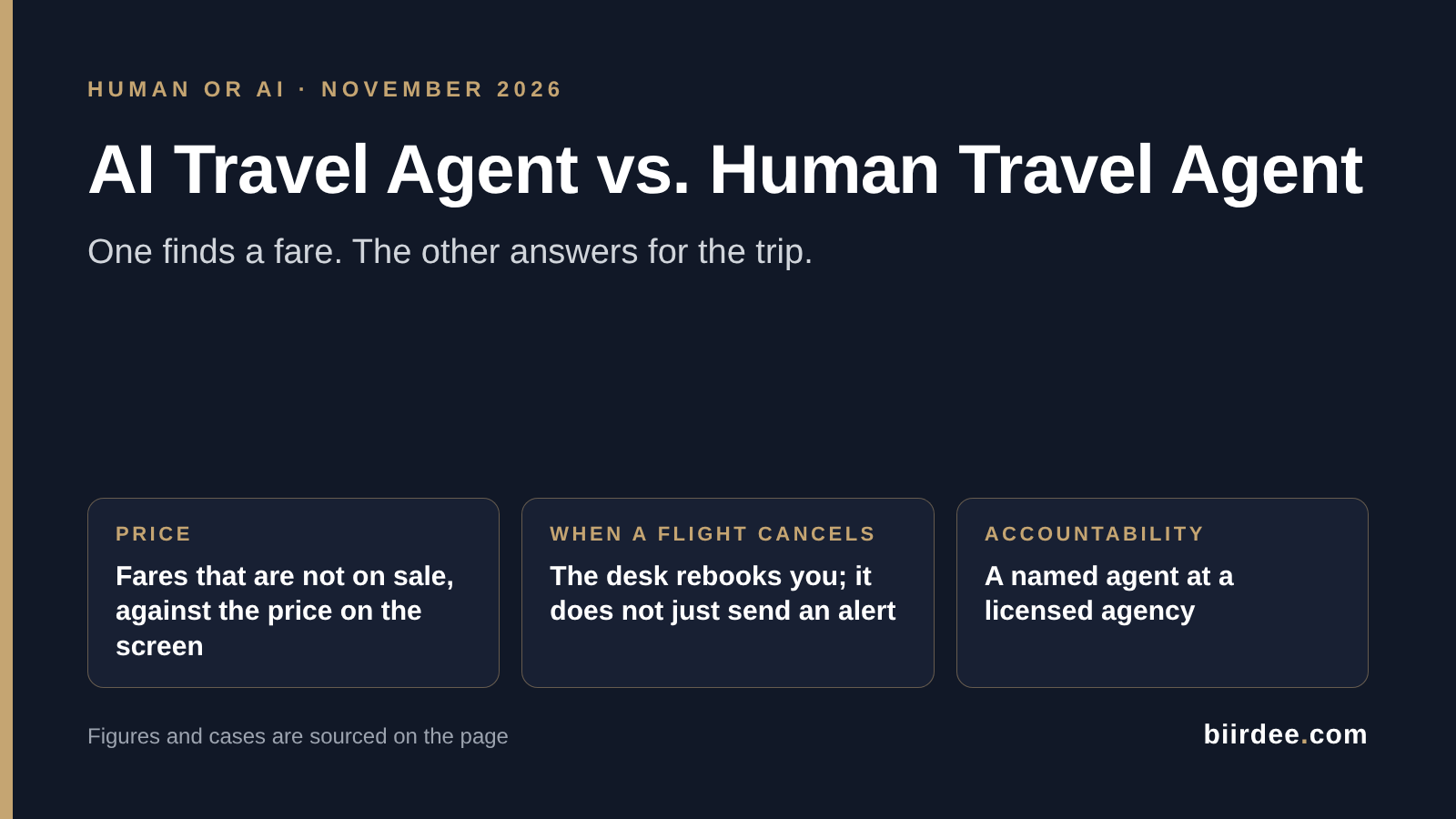
A human travel agent wins on three things software does not have. A specialist desk holds contracted fares that are not for sale on any site an AI can search, so on long-haul business and first class it usually starts below the published price. A person can pick up the phone, argue a waiver and rebook you while you sleep, where software mostly sends an alert. And a person at a licensed agency answers for the result, by name. When an AI tool gets something wrong, checking it was your job.
We are a human desk, so we are not neutral, and we use AI ourselves as a tool. This page links the source for every figure and case it cites, and says where the software is the better choice. As of November 2026, for any trip that is expensive, complicated or cannot go wrong, the person still wins, and it is not close.
Key Takeaways
- Price: an AI agent searches what is on sale. A specialist human desk books contracted fares that are not published anywhere, usually below the airline's own price on long-haul business and first class.
- Accuracy: in an August 2026 survey of US travelers who had used AI for travel, 55% had been given at least one bad recommendation and 16% had been recommended a place, tour or activity that did not exist.
- Accountability: a licensed agency and a named agent answer for the booking. In November 2026 a senior Citi executive was still calling who is liable for an AI agent's booking "the biggest question".
- Disruption: most AI agents watch your flight and tell you it is cancelled. A concierge desk rebooks it and moves the car and the hotel.
- Judgment: a person can tell you the plan is wrong, call the hotel, and know what "the usual" means after thirty trips.
- Where AI wins: ideas, a first draft of an itinerary, and simple trips where the price is the same whoever books it.
AI Travel Agent vs. Human Travel Agent at a Glance
The AI column describes AI travel agents in general as of November 2026 and leans on the three we have read closely: Axel, Miso and Atlas. Products differ, so check the one you are considering. The human column describes a specialist concierge desk such as ours.
| AI travel agent | Human travel agent (a specialist desk) | |
|---|---|---|
| What it is | Software that plans or books from a typed request | A team of named people at a licensed agency |
| Where the price comes from | What its integrations and the public web have on sale | That, plus contracted fares the airline does not publish, and award seats priced against cash |
| What it knows | What it was trained on and what it can look up, stated with the same confidence either way | What the desk has booked, flown and fixed; it says when it does not know |
| When it is wrong | You tend to find out on the trip, and the terms usually leave the checking to you | The agent who booked it puts it right, and the agency answers for it |
| When the flight cancels | Usually an alert; the change goes through you or a support channel | The desk rebooks you and moves the car and the hotel |
| A trip with many parts | Handles each piece; you hold the whole together | One desk holds the flights, jet, hotel, car and greeter together |
| Who you reach | A chat window or a support queue | The same people each time, on WhatsApp, phone and email |
| What it costs | Often free, sometimes a membership | At Biirdee, no booking fee and no membership on concierge bookings |
| Best for | Ideas, drafts, simple domestic and economy trips | Long-haul premium cabins and complex, last-minute or high-stakes trips |
What an AI Travel Agent Is, and What It Does Well
The phrase covers two different things. The first is a general AI assistant that you ask to plan a trip: it writes an itinerary, suggests hotels and explains the options. The second is a booking agent, a product built to search, hold your traveler details and your card, and buy the ticket, sometimes over text message. Some do both.
Both are useful. An AI assistant will turn "ten days in Japan in April, two adults, we like food and hate crowds" into a sensible outline in seconds, at any hour, and it never tires of follow-up questions. A booking agent saves you from opening six airline tabs, and a few watch a fare after you buy and try to recover the difference if it drops. Travelers have noticed. In TravelBoom's 2027 Leisure Travel Study, fielded in October 2026 and reported by TravelPulse, the share of leisure travelers using AI to plan trips rose from 63% to 67% in a year.
The same study found something else. The share who called AI trustworthy for travel recommendations fell from 67% to 56% over that year. More people are using it and fewer of them believe it. The rest of this page is about why.
Price: Software Searches What Is on Sale. A Desk Books What Is Not.
An AI agent can only sell what it can reach, so read how the products describe their own supply. Miso says its "prices are from the source", meaning the airline's own. Voyage Labs says Atlas books "through supplier partnerships". Axel advertises "private and off-market fares", and the examples on its home page were $91 against a $96 airline fare from Seattle to San Francisco and $160 against $169 for a New York to Orlando round trip. We read all three on 19 November 2026, and the sources are linked in our comparisons. They are honest descriptions of buying the fare that is on sale, or a few dollars under it.
The big gaps in air travel are somewhere else. Airlines sell unsold long-haul business and first class seats through private contracts with licensed agencies, at prices that never appear on the airline's site, on a booking site or in any feed software can read. Biirdee holds contracted fares with more than 45 major carriers, and every quote shows our price beside the published one, so the saving is a line you can check. The mechanics are in unpublished business class fares, and how we are paid is on how our pricing works: inside the fare, with no booking fee.
Then come the moves that take someone who prices these trips all day. Weighing your points against the cash fare, and telling you to keep the points when cash wins. Ticketing out on one airline and home on another. Building a stopover into the fare. Starting the journey from a city where the cabin is cheaper. An AI model can describe every one of those ideas. Describing a strategy and holding the contract that makes it bookable are different things.
On economy and simple domestic flights there is no such gap, which is why we tell people to book those direct. And when we cannot beat the published fare on a premium cabin, we say that too.
Accuracy: Fluent Is Not the Same as Right
A language model writes the most plausible answer to your question. Most of the time the plausible answer is also the true one. Sometimes it is not, and the model sounds exactly as sure of itself in both cases. In travel, a plausible wrong answer is a restaurant that closed last year, a ferry that does not run on Sundays or a connection nobody could make.
This has been measured. Greetwell commissioned a survey of 1,000 US adults in August 2026, all of whom had taken a leisure trip in the past year. Of the 485 who had used AI for travel, 55% had hit at least one bad recommendation, 27% had been given incorrect prices, hours or other details, and 16% had been recommended a place, tour or activity that did not exist.
Some of the stories behind those numbers are not funny. In 2025 the BBC reported on two travelers in Peru who set out for a "Sacred Canyon of Humantay" that an AI tool had described to them. There is no such place, and a local guide stopped them before they went looking for it in the mountains. We read the account in Futurism's report of 4 October 2025, which links the original.
A human agent is wrong sometimes too. The difference is where the knowledge comes from and what happens next. An agent who tells you that a 55-minute connection in Frankfurt is fine in the morning and reckless in the evening has watched it fail. And when an agent does get something wrong, the person who made the booking is the person you call, and putting it right is their job.
Accountability: When the Machine Is Wrong, Who Answers?
A traveler once asked the automated assistant on Air Canada's website about bereavement fares. It told him he could claim the reduced fare after he had travelled. The airline's real policy said the opposite, and it refused the refund. He took the airline to British Columbia's Civil Resolution Tribunal, where Air Canada argued that it could not be held liable for what its assistant had said. The tribunal member called that "a remarkable submission" and wrote: "It should be obvious to Air Canada that it is responsible for all the information on its website." The traveler was awarded CAD $812.02 (Moffatt v. Air Canada, 2024 BCCRT 149).
He won, and the principle is a good one. But look at what it took: a tribunal case over a few hundred dollars, against a company whose first answer was that the software's words were not its own. And that was an airline answering for its own website. An AI travel agent puts one more party between you and the airline, and nobody has yet settled what that party owes you. At a Skift conference in November 2026 a senior Citi executive called "who takes the agent liability" "the biggest question" for banks, card networks, merchants and AI companies (Skift, 11 November 2026).
A human agency is a simpler arrangement. Biirdee Inc. is a registered California Seller of Travel (CST 2138352) at 1415 Rollins Road in Burlingame, beside SFO. The people who quote and book are named on our team page. Every quote sets out the airline, the routing, the fare rules and the all-in price in writing, and nothing is booked until you say yes. After that the same desk owns the booking. If we get it wrong, you know exactly who to call.
Disruption: An Alert Is Not a Rebooking
Flights cancel at midnight, in snow, when every other passenger is trying to rebook too. This is where the two kinds of agent are furthest apart. Read an AI agent's feature list and the verbs are watch, monitor, notify, remind. Voyage Labs describes Atlas monitoring a trip and texting you. Axel's FAQ says that to modify or cancel a booking you contact its support. Those are fair designs, because nobody wants software changing a ticket without asking. It does mean that at midnight the problem is still yours.
A concierge desk works the other way round. Ours monitors the flights it books and rebooks cancellations, missed flights and schedule changes itself, including overnight. Because the same people booked the chauffeur, the airport greeter and the hotel, those move too, and the hotel is told you are arriving late so the room is held. The message you wake up to says what has been done. We also run a missed-flight helpline that takes travelers who did not book with us.
A person can also do things no interface offers: ring the airline's agency desk, ask for a waiver, hold a seat while you decide, and notice that the "available" rebooking would strand your connection in Munich.
Judgment: A Person Can Tell You the Plan Is Wrong
An AI assistant answers the question you asked. A good agent answers the one you should have asked. That means telling you the hotel you picked is in the middle of a renovation, that the Monday red-eye will wreck the Tuesday presentation, or that the whole trip is better started a day earlier from another airport. It also means saying no. On some days we cannot beat the published fare, and we say so.
Judgment gets better with a relationship. A Biirdee household or family office gets a named lead agent, the same person each time, and a file that holds passport details, trusted-traveler numbers, seat and cabin rules, hotel preferences and who approves the spend. AI products keep a profile too, and that memory is a good idea. The difference is who reads it. The agent who has booked your last thirty trips knows that "the usual" means the window on the left side and never the early flight on a Monday. That is why executive assistants and family offices keep a desk and not only a tool.
Much of high-end travel does not run through an interface at all. A private jet charter on four hours' notice, a hotel asked to hold a room for a guest landing after midnight, a group travelling to Cannes or a Formula 1 weekend: these are arranged by people on the phone to other people.
One Trip, Both Ways
A chief of staff in Palo Alto needs four business class seats from San Francisco to Milan on Thursday, a hotel on Lake Como, a driver, and a flight home from Nice ten days later.
Give that to an AI agent and a competent answer comes back fast: flights at the published fare or near it, a shortlist of hotels, and a booking flow where you review each piece and pay. Somebody still has to check that the names match the passports, that the hotel is open for the season and that the car takes four people and their luggage. If the flight home is cancelled, a message says so, and the chief of staff starts rebooking four people.
Send the same request to a human desk as one WhatsApp message. An agent prices the open jaw on contracted fares, checks whether the family's points do better than cash on one leg, and replies with two or three options that show the published fare beside ours. The hotel is booked at the direct rate, with partner perks where the property offers them, and the driver is booked against the flight number. If the flight from Nice is cancelled, the desk rebooks all four seats and moves the car. The chief of staff sent one message and said yes once.
The Narrow Case for the AI Agent
There are trips where software is the right tool and a human desk is the wrong one. Ideas for a free weekend. A first draft of an itinerary you mean to check yourself. A domestic hop or an economy ticket, where the fare is the published fare whoever books it and there is little for an agent to improve. Our own quote form warns of limited or no availability for US domestic and economy flights. We are glad to help with those, but they are not what the desk is built for.
Some people also prefer a product to a person, and enjoy the planning. That is a fair preference. If it is yours, use AI as a researcher whose work you check: our list of what to check in an AI trip plan covers the nine things to look at before you pay. And one caveat about our own side. Contracted fares come with their own change and refund rules, set out in writing before you pay, and changes go through our desk and not the airline's app. That trade-off is laid out in Biirdee vs. booking direct.
The Verdict: Why the Human Wins
AI has made the easy part of travel easier. Searching, summarising, drafting a plan: software does these well, and we use it for them ourselves. If that were the whole job, there would be nothing left to compare.
It is not the whole job. The job is getting a better price than the one on the screen, being right about details that software states with confidence either way, and being there at midnight when the flight cancels. On price, an AI agent reaches what is on sale and a specialist desk reaches what is not. On accuracy, more than half of the AI-using travelers in one survey had been given something wrong. On accountability, the people who move the money were still asking in November 2026 who pays for an AI agent's mistake. A human desk settled all three long ago, with contracts, experience and a name on the booking.
So use AI the way a good agent does, as a tool. Then give the trip that costs real money, or cannot go wrong, to a person who will answer for it.
AI vs. Human Travel Agent FAQs
Is an AI travel agent better than a human travel agent?
For ideas, a first draft of an itinerary and simple trips at the published price, an AI travel agent is quick and good enough. For long-haul business and first class, multi-city or last-minute trips, private jets and anything that cannot go wrong, a human agent is better: a specialist desk books contracted fares below the published price, rebooks you when a flight cancels and answers for the booking.
Can an AI travel agent find cheaper business class flights than a human?
Usually not on long-haul routes. An AI agent sells what its integrations and the public web have on sale. The lowest legitimate cash fares in business and first class are contracted fares that airlines sell only through licensed agencies and do not publish. Ask a specialist desk for a free quote and compare it with the fare the AI showed you; our guide to unpublished business class fares explains why the two differ.
Who is responsible if an AI travel agent books the wrong flight?
It depends on the product's terms and on your local law, and the question is not settled. In November 2026 a senior Citi executive called who takes liability for an AI agent's purchases "the biggest question" in the industry. In practice the AI booking tools we have read ask you to review and confirm before paying, which makes the checking yours. With a human agency, the agency that issued the ticket answers for it.
Will AI replace human travel agents?
It is replacing the parts of the job that were search and data entry, and that suits us. What is left is what this page is about: prices that are not on sale to the public, judgment, and fixing a trip when it breaks. Those rest on contracts, relationships and accountability, not on how well a model writes. More on the trade is in why travel agents still exist.
Does Biirdee use AI?
Yes, as a tool. Our hotel pages carry an automated assistant for quick questions about rates, and the desk uses software to search fares and watch flights. A person reads every trip request, prices it, writes the reply and answers for the booking. The people are named on our team page.
Can I plan a trip with AI and book it with a human agent?
Yes, and it is a good way to work. Use AI to explore ideas and draft the outline, then send the plan with your trip request. An agent prices the flights and hotels, tells you what they would change and books what you approve.
Does a human travel agent cost more than an AI travel agent?
Not at Biirdee. Quotes are free, and there is no booking fee, retainer or membership on concierge bookings. We earn inside the contracted fare, which is usually below the published price on long-haul premium cabins, so the human often costs less than the software. The detail is on how our pricing works.
What Biirdee Does
A flight desk for business & first, run by fare and miles experts
Biirdee’s flight specialists price every itinerary across cash fares, miles, and partner channels, then book the strongest option, with a human concierge on the reservation from quote to gate.
Tell us the route
Origin, destination, rough dates, cabin. The form takes two minutes and commits you to nothing.
Specialists price it every way
Cash vs. miles vs. partner fares across alliances: every premium-cabin option priced individually for your dates, with honest advice when a published fare is already the right answer.
Book and fly with backup
A dedicated concierge from quote to gate: schedule changes, seats, and disruptions handled for you.
Need the hotel too? The same team books luxury hotels at the direct rate with partner perks attached.
Biirdee · Flight Concierge
Send the Trip to a Person
One message with the route, the dates and what matters. A named agent replies with two or three options in writing, each beside the airline's published fare, and stays on the trip until you are home. Free, with no booking fee.
Questions?[email protected]
Prefer to book it yourself at net fares?
Biirdee Pro members book flights & hotels at net rates: $100/mo, cancel anytime.
Keep reading
Related Guides
Travel Agents & Concierge
Why Not to Use an AI Travel Agent: Seven Reasons, With the Evidence
Travel Agents & Concierge
Planned a Trip With AI? Nine Things to Check Before You Pay
Travel Agents & Concierge
Should I Use a Travel Agent? An Honest Answer (2026)
Travel Agents & Concierge
What Does a Travel Concierge Do? An Honest Answer (2026)
Travel Agents & Concierge
Biirdee vs. Atlas by Voyage Labs: An AI Agent in Beta, or People Who Answer for Your Trip
Travel Agents & Concierge
Biirdee vs. Axel (HelloAxel): Software Can Shave a Fare. It Cannot Run Your Trip.