Why Not to Use an AI Travel Agent: Seven Reasons, With the Evidence
An AI travel agent is a clever researcher and a poor travel agent. Seven things go wrong when you hand it the booking, with the evidence for each and what a human desk does in its place.
By Biirdee Travel, Luxury Travel Concierge · Updated November 23, 2026
The Short Answer
Do not hand a trip that matters to an AI travel agent, for seven reasons. It states wrong details as confidently as right ones. It sells the price that is on sale and cannot reach the ones that are not. It leaves the final check to you. Nobody has settled who pays when it gets a booking wrong. When your flight cancels, it tells you. It cannot pick up a phone. And it answers the question you typed, not the one you should have asked.
None of that makes AI useless for travel. It is a fine way to get ideas and a first draft, and for a cheap, simple trip the stakes are low enough that its mistakes cost little. The trouble starts when the trip is expensive, complicated or cannot go wrong, which is exactly when people most want someone else to handle it.
We are a travel agency staffed by people, so weigh this accordingly. Every figure and case below carries a link to its source, and the page ends with the trips on which we would tell you to use the software.
What Travelers Who Used AI Reported
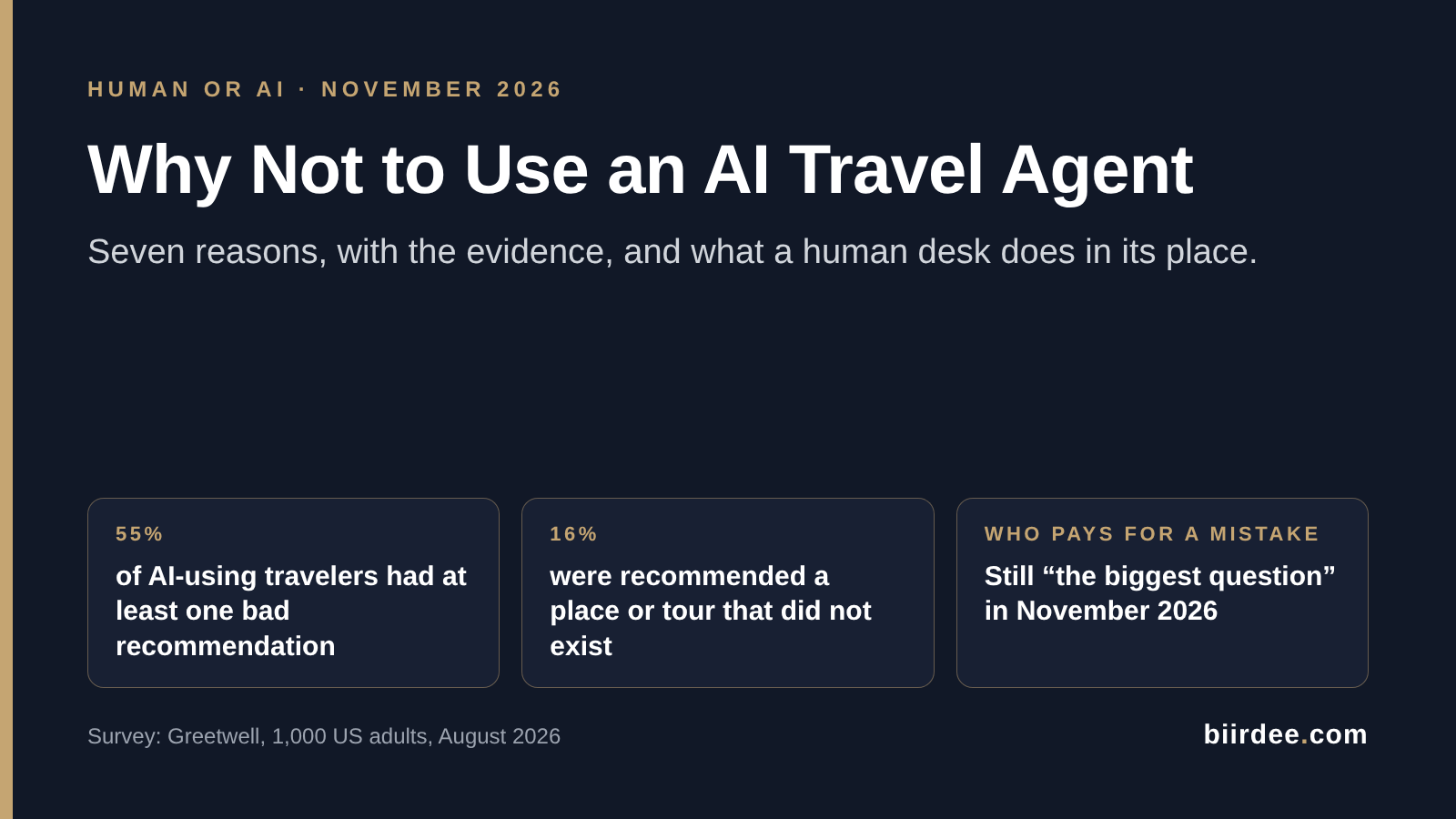
- had at least one bad recommendation
- 55%
- were given wrong prices, hours or details
- 27%
- were recommended a place or tour that did not exist
- 16%
Key Takeaways
- The figures above are from a survey Greetwell commissioned in August 2026: 1,000 US leisure travelers, of whom 485 had used AI for travel.
- Trust is falling as use rises. In TravelBoom's October 2026 study, travelers using AI to plan rose from 63% to 67% in a year, while those calling it trustworthy for travel recommendations fell from 67% to 56%.
- An AI agent searches what is on sale. The lowest long-haul business and first class fares are contracted fares that airlines do not publish and sell only through licensed agencies.
- Liability is unsettled. In November 2026 a senior Citi executive called who takes responsibility for an AI agent's purchases "the biggest question" for banks, card networks, merchants and AI companies.
- Most AI agents watch a trip and send alerts. A human concierge desk rebooks the cancelled flight and moves the car and the hotel.
- AI is a good researcher. Use it for ideas and drafts, then have a person price, book and answer for the trip.
1. It Is as Confident When It Is Wrong as When It Is Right
A language model produces the most plausible answer, and in travel the plausible answer and the true one part company more often than you would like. In the Greetwell survey, more than half of the travelers who had used AI for a trip had been given at least one bad recommendation. The commonest fault was incorrect prices, hours or other details (27%). Then came things that were fully booked or unavailable (21%), suggestions that were simply wrong for what was asked (17%), places, tours or activities that did not exist (16%) and businesses that had permanently closed (10%).
The BBC collected some of these stories in 2025. Two travelers in Peru set out for a "Sacred Canyon of Humantay" that an AI tool had described to them. No such place exists, and a local guide stopped them before they went looking for it at altitude. A couple climbing Mount Misen in Japan relied on an AI assistant for the time of the last ropeway down, found the station already closed, and were stranded on the mountain. We read both in Futurism's account and a later summary, which link the original report.
Nothing in the answer tells you which sentence is the invented one. That is the real problem. A human agent can be wrong too, but an agent who is unsure says "let me check", and then checks.
2. It Sells the Price on the Screen
An AI agent can only sell what it can reach: the fares in its integrations and on the public web. The products say as much. Miso says its "prices are from the source". Voyage Labs says Atlas books "through supplier partnerships". Axel advertises "private and off-market fares", and the examples on its home page were $91 against a $96 airline fare and $160 against $169. Those are their own words, read on 19 November 2026 and linked in our comparisons of Miso, Atlas and Axel.
A few dollars on a short flight is a real saving. It is also the wrong place to look. The large gaps are in long-haul business and first class, where airlines sell unsold seats through private contracts with licensed agencies at prices that appear on no website and in no feed. Biirdee holds contracted fares with more than 45 major carriers and shows the published fare beside ours on every quote, so you can see the gap for yourself. The mechanism is explained in unpublished business class fares.
A desk also does things with a fare that a search does not. It prices your points against cash and tells you which to use. It tickets out on one airline and home on another, builds in a stopover, or starts the journey from a city where the same cabin is cheaper. An AI model can explain all of that. It cannot issue the ticket on a contract it does not hold.
3. The Final Check Is Still Your Job
The companies building AI agents know they make mistakes, and to their credit they say so. When OpenAI released its first agent that could act in a web browser, in January 2025, its own safety paper warned that the agent "may inadvertently buy the wrong product, causing some financial loss to the user". In its tests of the model before safeguards, 100 prompts produced 13 errors, and it described 5 of them as "to some degree, irreversible or possibly severe". That was an early research preview and the tools have improved since.
What matters is the safeguard its builders chose, because the booking agents we have read use a version of it: before anything is bought, the software stops and asks you to confirm. OpenAI reported that confirmations cut the risk by about 90%. Axel says it does not change or cancel a booking without your explicit approval. On Voyage Labs' site, you review the bookings and complete the payment yourself.
That is responsible design, and it puts the proofreading back on your desk. You are the one checking that it is Thursday and not Tuesday, the right Portland, a name that matches the passport and a fare that can be changed. If you miss it, you approved it. A human agent also sends the itinerary for your yes. The difference is that a person whose job it is has already read it, and the agency that issues the ticket answers for what is on it.
4. Nobody Has Settled Who Pays for Its Mistakes
A traveler once asked the automated assistant on Air Canada's website about bereavement fares, and it told him he could claim the reduced fare after travelling. The airline's policy said otherwise and it refused the refund. Before British Columbia's Civil Resolution Tribunal, Air Canada argued that it could not be held liable for information given by its assistant. The tribunal member called this "a remarkable submission", wrote that "it should be obvious to Air Canada that it is responsible for all the information on its website", and awarded the traveler CAD $812.02 (Moffatt v. Air Canada, 2024 BCCRT 149).
The traveler won. He also had to bring a case to do it, against a company whose first position was that the software's words were not its own. An AI travel agent adds a further party between you and the airline, and its terms shape what it owes you. Lawyers at Morgan Lewis, writing in August 2026, noted that such terms "may state that the AI concierge is merely a tool, does not act as an agent, or lacks authority to bind the platform", and that consumer terms often "place responsibility on the traveler to review confirmations". They add, fairly, that consumer protection law does not vanish because AI wrote the statement.
The money side is no clearer. At a Skift conference in November 2026 a senior Citi executive called "who takes the agent liability" "the biggest question" that banks, card networks, merchants and AI companies are trying to answer (Skift, 11 November 2026). Until they answer it, you are the test case.
With a human agency there is nothing to untangle. Biirdee Inc. is a registered California Seller of Travel (CST 2138352) with an office at 1415 Rollins Road in Burlingame, and the people who book are named on our team page. The quote is in writing, the fare rules are on it, and the desk that issued the ticket is the desk that fixes it.
5. When the Flight Cancels, It Tells You
Look at the verbs in an AI travel agent's feature list: watch, track, monitor, notify, remind. Voyage Labs describes Atlas monitoring your trip and texting you about check-in times and gate changes. Axel's FAQ says that to modify or cancel a booking you contact its support. An alert at midnight is better than finding out at the gate. It is still the start of your problem and not the end of it.
Our desk monitors the flights it books and rebooks cancellations, missed flights and schedule changes itself, including overnight. The chauffeur, the airport greeter and the hotel were booked by the same people, so they move as well, and the hotel is told to hold the room. You wake up to a new itinerary. We also run a missed-flight helpline that takes travelers who did not book with us.
6. It Cannot Pick Up the Phone
A good deal of travel is still settled between people. An airline's agency desk will sometimes grant a waiver to an agent who asks properly. A seat can be held while a client decides. A hotel will keep a room for a guest landing after midnight because someone it knows rang ahead. A private jet on four hours' notice is found by a person calling operators, not by a search box.
Software works through interfaces, and an interface offers only what its owner chose to put in it. Voyage Labs says one of Atlas's agents "works across the web where there's no API", which is clever, but browsing a website is not the same as being owed a favor. The founder of our desk has spent 18 years in the flight industry. Relationships of that kind do not come with a subscription.
7. It Answers the Question You Typed
Ask an AI assistant for the cheapest business class fare to Singapore on the 14th and it will look for one. A good agent will ask why the 14th, and mention that the 13th is far cheaper, or that the cheapest seat is on an aircraft with the old cabin, or that your connection lands twenty minutes after the meeting starts. The most valuable thing an agent says is often "I would not do it that way".
An AI agent knows what you told it in the conversation and whatever its profile has stored. That memory is useful, and the better products are built around it. A named lead agent who has booked a household's last thirty trips knows things nobody typed: that the principal will not take a red-eye before a board meeting, that the youngest needs the bulkhead, that "somewhere warm in February" has meant the same three hotels for six years. That is why executive assistants and family offices keep a desk and not only a tool.
Six Questions to Ask an AI Travel Agent Before You Give It Your Card
If you are going to try one, ask these first. The answers should be on its website. We set ours beside them.
Who is the seller, and where is the company? Ours is Biirdee Inc., Burlingame, California, Seller of Travel CST 2138352. Where do your prices come from? Contracted fares with more than 45 airlines, and award seats priced against cash, with the published fare shown on every quote. Who changes my ticket when the flight cancels, and at what hour? Our desk does, at any hour.
Can I reach a person, and how? WhatsApp, phone and email, with a first WhatsApp reply in under four minutes on average during business hours. What do your terms say about a booking error? The quote, the fare rules and the price are in writing before you pay, and the desk that booked it fixes it. What does the service cost? No booking fee and no membership on concierge bookings.
An AI product that answers all six plainly deserves a look. Of the three we read in November 2026, two did not state where the company is and two published no price for the service.
When an AI Travel Agent Is Fine
Use one for ideas: where to go in March, how to split ten days between two cities, what a neighborhood is like. Use one for a first draft that you will check, and our list of what to check in an AI trip plan covers the nine things worth a look. Use one, or book direct, for a domestic hop or an economy ticket, where the price is the published price whoever sells it. Our own quote form warns of limited or no availability for US domestic and economy flights. We are glad to help with those, but they are not what the desk is built for.
The honest dividing line is the cost of being wrong. A mistake on a $200 flight to see friends is an annoyance. A mistake on four business class seats for a family, or on the flight that gets a founder to a signing, is a different matter. For how the human option compares point by point, see AI travel agent vs. human travel agent.
The Verdict: Use the Machine to Think and a Person to Book
Every one of the seven problems is a missing person. Someone who knows the place is real. Someone with a contract for a better fare. Someone who reads the itinerary before you do, whose name is on the ticket, who is awake when the flight cancels, who can ring the airline, and who knows you well enough to disagree with you.
AI will keep getting better at the research, and we are glad of it, because we use it too. But being answerable for a trip is not something a model can be given in an update. That is the product a travel agent sells, and at Biirdee it comes with no booking fee and, on long-haul premium cabins, usually a lower price than the one the software found.
AI Travel Agent FAQs
Is it safe to use an AI travel agent?
For ideas and simple, low-cost trips, yes, if you check the details yourself. For an expensive or complicated trip the risks are real: AI tools state wrong details with confidence, most leave the final check to you, and who is liable for a mistaken booking is not settled. In an August 2026 survey, 55% of US travelers who had used AI for travel had received at least one bad recommendation.
What are the disadvantages of AI travel agents?
Seven stand out: confident errors, prices limited to what is on public sale, the final check left to the traveler, unsettled liability for mistakes, alerts in place of rebooking when a flight cancels, no ability to call an airline or a hotel, and no judgment about whether the trip you asked for is the right one.
Do AI travel agents make up places and details?
They can. In a survey Greetwell commissioned in August 2026, 16% of US travelers who had used AI for travel said it had recommended a place, tour or activity that did not exist, and 27% had been given incorrect prices, hours or other details. Check every place, opening time and price against an official source before you rely on it.
Can an AI travel agent rebook me if my flight is cancelled?
It depends on the product, so ask before you book. The AI agents we have read mostly monitor a trip and notify you, and route changes through you or their support. A concierge desk such as Biirdee monitors the flights it books and rebooks cancellations itself, including overnight.
Are AI travel agents cheaper than human travel agents?
Not necessarily. Many AI agents are free, and so is a Biirdee quote: there is no booking fee or membership on concierge bookings. On long-haul business and first class, a specialist human desk usually prices below the published fare an AI agent shows, because it books contracted fares that are not publicly on sale. On economy and domestic flights the prices are much the same everywhere.
What should I use instead of an AI travel agent?
For a simple trip, the airline's own website. For long-haul premium cabins, multi-city or last-minute travel, private jets, or anyone booking for an executive or a family, a human concierge desk. Our guide to whether to use a travel agent sets out which trips fall on which side.
What Biirdee Does
A flight desk for business & first, run by fare and miles experts
Biirdee’s flight specialists price every itinerary across cash fares, miles, and partner channels, then book the strongest option, with a human concierge on the reservation from quote to gate.
Tell us the route
Origin, destination, rough dates, cabin. The form takes two minutes and commits you to nothing.
Specialists price it every way
Cash vs. miles vs. partner fares across alliances: every premium-cabin option priced individually for your dates, with honest advice when a published fare is already the right answer.
Book and fly with backup
A dedicated concierge from quote to gate: schedule changes, seats, and disruptions handled for you.
Need the hotel too? The same team books luxury hotels at the direct rate with partner perks attached.
Biirdee · Flight Concierge
Ask a Person to Price the Same Trip
Send the route and dates, and the fare your AI agent found if you have one. A named agent replies with two or three options in writing, each beside the airline's published fare. Free, with no booking fee.
Questions?[email protected]
Prefer to book it yourself at net fares?
Biirdee Pro members book flights & hotels at net rates: $100/mo, cancel anytime.
Keep reading
Related Guides
Travel Agents & Concierge
AI Travel Agent vs. Human Travel Agent: One Finds a Fare. The Other Answers for the Trip.
Travel Agents & Concierge
Planned a Trip With AI? Nine Things to Check Before You Pay
Travel Agents & Concierge
Should I Use a Travel Agent? An Honest Answer (2026)
Travel Agents & Concierge
Why Travel Agents Still Exist in 2026: The Honest Economics
Travel Agents & Concierge
Biirdee vs. Atlas by Voyage Labs: An AI Agent in Beta, or People Who Answer for Your Trip
Travel Agents & Concierge
Biirdee vs. Miso: Booking by Text Is the Easy Part. The Price Is the Hard Part.